The truth behind the Airbnb lies

303
555

Analyzing the $8 million corporate campaign to stop effective regulation of short-term rentals
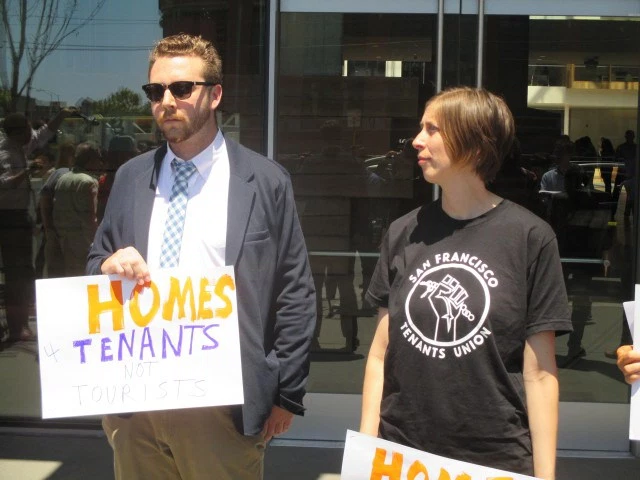
 Landlords (Charlie Goss from the Apartment Association) and tenants (Jennifer Fieber from the SF Tenants Union) are united, for once, in favor of regulating Airbnb
Landlords (Charlie Goss from the Apartment Association) and tenants (Jennifer Fieber from the SF Tenants Union) are united, for once, in favor of regulating Airbnb

By Sara Shortt

Disclosure: I would find it funny if anyone ever called me a “paid shill,” but I do work as the Executive Director of the Housing Rights Committee of SF, a nonprofit tenants rights organization that offers free counseling for San Francisco tenants in all types of housing, including rent-control, SROs, public housing and Section 8.  I am a long-time SF resident and while I hope that people read things before they vote, I actually hope that they get involved in local issues beyond just reading. 

OCTOBER 13, 2015 – To Emey (and the people who are wondering whether to believe the $8 million Airbnb campaign):

I really enjoyed your recent piece – the dramatically titled “I Have Read Prop F, and It is Way Worse Than You Think” – that is getting passed around the Internet. I know that if you say something enough, people are bound to believe it, so I thought I’d respond via an open letter. And with Airbnb, the primary funder of No on F, spending $8 million on a fear campaign to spread lies about Prop F, – I thought it would be a good opportunity to set the record straight.  Never believe everything that a multi-billion-dollar corporation tells you. Unfortunately, big corporations lie all the time when it’s profitable – as thousands of VW owners just found out.

There’s a lot of fun stuff in your piece to address – a lot of which is addressed in the recent piece “I Have Read Prop F And It’s Perfectly Normal” – but I think it’s important to educate voters about what’s happening with housing in the city, the effects of short-term rentals and why I think we must pass Prop F to protect our neighborhoods.

First, let me get this out of the way: You say, “It’s actually really hard to find the text online” and “…you’ll see exactly why they don’t want you to read the text.” Really? Have you ever used Google? I typed “text prop F sf” in the search bar and…hey, here’s the text of Prop F! In 20 seconds. (p.s., all that money Airbnb spent on Google ads is working: The No on F link pops up at the top even if you search for Pope Francis. Glad all that money is getting the company something.) I guess you can fault the campaign for not including a link on its website, but to say the text is hard to find is ludicrous.

Now, on to the real issue:

 

Airbnb is Not Helping the Housing Crisis, It’s Making Things Worse

I’ve worked on tenants’ rights and affordable housing here in the city for about 20 years, and right now, our housing situation is the worst that I’ve ever seen. There have been about 10,000 evictions since 2010, most fueled by real estate speculation and the new profit found in renting to high-paying tourists rather than long-term tenants (who have, you know, rights and stuff).  Ellis Act, owner move-in, nuisance violations, illegal intimidation – you name it and it’s happening now. Every tenant in the city knows that if he or she has to leave an apartment, their time in San Francisco is over.

I think what I find most fascinating (and troubling) about the discussion around Prop F is how Airbnb and the other 60 or so hosting platform companies get a complete pass on any responsibility for what their business model is doing to neighborhoods and housing markets, and the fact that they intentionally turn a blind eye to the many abusers on their sites who openly break the law (more on that later). Ignoring the law and undoing years of carefully thought out housing regulations isn’t an innovation, it’s simply putting profit over people. This isn’t the “sharing” economy, it’s the profit economy — and right now, Airbnb is profiting off of our housing crisis.

Prop F didn’t come out of nowhere, and it was not created in the backrooms of the hotel industry. I am part of the coalition of tenant and housing groups that moved to put it on the ballot when it became clear that City Hall was going to cater to corporations like Airbnb rather than solve the short-term rental issue.

San Francisco and literally hundreds of cities all over the world are dealing with the fact that the Airbnb model has gutted the basic foundation of housing regulations in every city where it exists (let’s not forget that Airbnb was illegal in SF from its start in 2008 to February 2015, ignoring the law while city government did nothing). We have a severe housing crisis and Airbnb is making it worse:  Rather than use much-needed housing for residents, we are instead using it for tourists. For cities like San Francisco with extremely tight housing markets – including Berlin, Paris, Barcelona, and New York City – the problem is even worse.  For more information on the importance of regulating short-term rentals, read here.

“What concerns us is when someone purchases one or more properties with the aim to turn them into tourist rentals. We don’t have enough properties to house Parisians.” said Ian Brossat, Paris’ deputy mayor in charge of housing.


Deputy Mayor Brossat could have been speaking about San Francisco.

Consider:

  • More than two thirds (68%) of all short-term rentals in San Francisco are for entire homes/units, not spare rooms.
  • Airbnb and VRBO alone account for roughly 4,500 entire homes and apartments removed from the San Francisco rental market. They’ve taken away 1,000 units more than the 3,500 new units San Francisco built in all of 2014.
  • In addition to Airbnb and VRBO, over 60 other companies offer short-term rentals to tourists, meaning SF may have lost up to 10,000 units to full-time tourist accommodation. That drives up rents. And it incentivizes evictions.


The Current Law Is Unenforceable

The No on F side says that we already have a law and should give it a chance to work. But we already know the law doesn’t work. It was built to fail by Airbnb’s friends in City Hall. Let’s look at a couple of examples: Emily Benkert  has 10 active Airbnb listings. Do you think she is the primary resident of each of them, as required by the current law? She’s definitely not registered with the city. Or take Fergus O’Sullivan, who has left a trail of evictions and illegal tenancies. Or maybe Vic Wang who has no less than 28 active Airbnb listings. Working folks renting a spare room to make ends meet? Yeah. Right.

We also know from experience that the city did nothing for years when short-term rentals were illegal (2008-2015) prior to the new law and the city did no enforcement against even the most obvious violators.

For example, there have been 350 complaints re: short-term rentals filed with the city since the beginning of 2014 and only nine notices of violation. Only 2% of complaints are actual violations and all nine of these were issued just weeks before this current election? Coincidence?

And virtually nothing is being done about these abuses.

Why? Because the current law is unenforceable, and that’s intentional. In the midst of the city’s worst housing crisis in over 50 years,  the law allows people like Emily and others to take multiple units and homes off the market and illegally list them on sites like Airbnb with no repercussions. And in the meantime, Airbnb continues to make money off these illegal listings.

As of September 2015, only 600 out of the 5,400 SF listings on Airbnb have actually registered with the city. Yes, that’s right – 90% of Airbnb’s listings are illegal — but under the current law, nothing happens.

We have no way of enforcing” the new law, said Planning Department communications Manager Gina Simi.

 That’s not me talking, it’s the city’s own Planning Department. In a memo earlier this year the department called the current law “unenforceable” and laid out the ways that the current law can be flouted:

  • Without Airbnb providing its data to city officials, city regulators can’t be sure that every host on the site is registered and paid up.
  • Officials who are supposed to enforce the law have no way to know whether somebody was or wasn’t in the house for 90 days.
  • The $50 registration fee isn’t enough to cover the cost of administering the law.


What the law needs, according to the Planning Department, is:

  • Booking data from the online services, so the department can crosscheck to see that rentals being offered are registered with the city.
  • A straight cap on the number of days any unit can be rented out per year. Current law limits rentals of unit to 90 days if the owner isn’t home — something that’s “virtually impossible” to prove.
  • A way to cover the actual cost of administering the law, which the two-year, $50 registration fee doesn’t come close to doing.


Were any of those suggestions included when the Board of Supervisors amended the law in July? NO. Rather than give the law teeth with real enforcement mechanisms, as their own Planning Department requested, all the supervisors added was window dressing, the new Office of Short-Term Rental Administration that has no new enforcement powers.


Airbnb and Other Companies Could Stop Abuse Right Now But Refuse

Here’s the kicker, Emey:  Airbnb and the other companies could put a stop to the vast majority of short-term rental abuse by simply allowing only units or homes legally registered with the city to be listed on their site. No registration? No listing. Pretty simple. they refuse, despite the clear number of bad actors abusing the system, because they make money off of those illegal listings. Thanks Airbnb!


Criminal Penalties? You’re In Jail? Really?

The criminal penalties section, including the penalty being a misdemeanor, comes directly from the current law, you know the one that Airbnb now asks you to “let work”, – we didn’t invent this nor did we create the penalties for misdemeanors. Try reading Supervisor Chiu’s legislation before you try to scare folks about Prop F.

Not knowing about a law isn’t an excuse if you end up breaking it. This applies to almost every law, not just Prop F.


Spying On Your Neighbors? What Planet Do You Live On?

I’m not even sure where to start with this. The billboards with people using binoculars to spy on each other? Incentivizing people to spy?  Puh-leeze.

Prop F simply lets San Franciscans protect our neighborhoods when City Hall can’t or won’t. Right now, if you see Airbnb abuse – say, apartments in your rent-controlled building illegally turned into tourist hotels, disrupting life for everyone – there’s not much you can do.  Prop F at least gives you a chance to make your case in court and have a shot at getting it fixed but that only happens if the city fails to act.

Lawsuits are how we protect our rights when government won’t help. Lawsuits helped right the wrongs done to victims of tobacco industry lies and Enron’s fraud. What the No on F side doesn’t want you to know is that what they really fear isn’t neighbors suing neighbors, but rather neighbors suing Airbnb and other web hosting platforms for breaking the law.

With regards to neighbors suing neighbors, you still have to get and pay for a lawyer.  You have to do intensive, rigorous investigation. And you have to actually provide strong evidence to prove your case. You may get your costs back, but only if you win. Not a guarantee – you need a strong case. Seeing someone enter or leave a home once with suitcases isn’t enough to clear that bar.

We have experience with this. The expedited condo conversion law had a provision that condo conversions would be halted if a lawsuit was filed — not won, just filed – and there were predictions of the courts being overrun by lawsuits, just like No on F says now. In the end no lawsuits were ever filed.

This section also came from the current law:

In addition, an owner, or, business entity in violation of this Chapter or a Hosting Platform in violation of subsection may be liable for civil penalties of not more than $1,000 per day for the period of the unlawful activity. If the City or the interested Party is the prevailing party, the City or the interested Party shall be entitled to the costs of enforcing this Chapter 4A, including reasonable attorneys’ fees, to the amount of the monetary award, pursuant to an order of the Court.


That’s what Prop F does – it simply gives interested parties (neighbors) the right to take action to ensure that the law is enforced. This is how Americans have protected themselves from corporate abuse since the 1800s. In Prop F, it simply means that if the city doesn’t take action or resolve your complaint in 90 days, then you have the right to sue to ensure that they do. Why? Because we don’t trust City Hall to enforce the law, since it hasn’t enforced the current one.

If you really believe a multi-billion-dollar corporation is spending $8 million on the No on F campaign because it’s deeply concerned about your privacy rights (read Airbnb’s terms of service – you don’t have any privacy) or cares about your relations with your neighbors, I’ve got a bridge to sell you.


Banning In-Law Units for Short-Term Rentals (ABSOLUTELY)

To answer your questions, yes: Prop F does ban the use of in-law units for short-term rentals. This might be the first true thing that the No on F side has said, and the provision is there for a good reason.

The city spent years working on legislation finally passed in 2014 to legalize an estimated 30,000 to 50,000 in-law housing units, specifically to increase affordable housing opportunities for working families who live in San Francisco, not tourists. It makes no sense to turn around a year later, in the midst of a massive housing crisis, to suddenly use those same units for short-term rentals to visitors.  Owners of in-law units would not be harmed because those units are not their primary residences.

But if you don’t believe me, then check out what then-Supervisor Chiu said about in-law units in his own press release.

“As housing costs have skyrocketed and working families are struggling, we must act quickly to address San Francisco’s affordability crisis,” said Board President David Chiu. “That’s why I’m introducing legislation that will create a pathway to legalize tens of thousands of in-law units, which will help tenants live in safe, affordable housing and homeowners have a good, long-term economic investment.” (November 2013; emphasis added)


$8 Million Dollar Fear Campaign

One question I had before this campaign started was whether or not Airbnb would spend more fighting Prop F than the $10 Million PG&E (another benevolent corporation) did in 2008 to fight Prop H, an initiative to create public power in San Francisco. Or whether or not the company would spend more than the real estate industry did last year to fight Prop G, the real estate speculation tax.

See a pattern? Any time citizens try to regulate corporations, they respond by spending millions to stop it. Like any other corporation, Airbnb is fighting fair, reasonable regulations by making the simple idea of regulation seem radical, or dare I say, “extreme.”

Unfortunately, we know from sad experience that big companies lie to protect their profits. Just ask any Volkswagen diesel owner.

I can say pretty safely that in all my years of political involvement that I have never been on the same side of a local issue as Dianne Feinstein. But as a former mayor, she understands what short-term rentals are doing to the city and why it matters so much.

Other cities like Santa Monica, Berlin, Paris and Barcelona banned Airbnb. Prop F does nothing of the sort — it simply sets fair, reasonable rules for those wishing to rent out an extra room from time to time, or their entire house when on vacation. Prop F holds corporations like Airbnb accountable by limiting ‘hosting platforms’ to listing only units that are properly registered with the City, so the city can enforce the law. It’s not rocket science.  We’re just trying to reasonably regulate one of the most vital assets – housing – that the city has in the face of a wealthy tech industry that wants to commodify absolutely everything without regard for who it hurts along the way.

Being held accountable is why Airbnb is spending $8 million against Prop F.


  • voltairesmistress

    This a great piece of political writing. The author elucidates the main issues and addresses most of the opposition’s arguments. Seems like Yes on F is the prudent choice for San Franciscans of many political stripes.

    Before I read this piece, I wasn’t sure how I was going to vote on F, because I found some of its provisions a little much: 75 rather than 90 days as a limit; and prohibition on a renter listing his in-law unit during his vacation, if his landlord agreed. But except for those two minor over-reaches, I think now that Prop F is basically a good law. I only wish our Board of Supervisors and Mayor had done this legislatively, instead of having it go to a less than perfect ballot measure. Alas, Mayor Lee has shown no leadership on this aspect of the housing crisis, so we voters have to.

    • GB85

      Suppose Airbnb lets stop entirely? Then what? What have you really gained? Vacant units? Unaffordable long-term rentals? More million dollar TIC’s and condo’s? More changes of use to commercial or semi-commercial?

      Some people seem to have an irrational hatred of Airbnb, but this has nothing to do with the alleged housing crisis. Not one low-income person will be housed if F passes. While owners will just find other ways to get around the restrictions.

      • voltairesmistress

        I have no ill feeling toward AirBnPB or any of the hosts, and I believe a lot of San Franciscans like me think that the vacation rental business us basically a great addition to the City and the Bay Area, as long as apartments remain in the long term rental market and are made available for tourists whenever residents are out of town. But in cities that have severe housing deficits like the Bay Area’s cities and towns, we have to regulate the market to produce outcomes that serve residents. Turning permanent housing stock into nearly continuous hotel-like accommodations is not in residents’ or neighborhoods’ best interests.

      • Meat Bikini

        “Suppose Airbnb lets stop entirely? Then what?”

        The market would obviously correct itself to the supply and demand model.

        Airbnb isn’t necessary to facilitate regulated home rentals. That much is plain.

        Bring on more disruption by new and agile, community aware upstarts!

        Airbnb are already the dinosaurs for the post #occupy generation of business people that are coming in their droves to SF and rejecting wallstreet.

    • Nancy Snyder

      yes, this is a great article explaining the issues and the Mayor has demonstrated no leadership on any issue

  • http://www.duckthefodgers.com/ Trademark Dave

    Let the #paidtroll bullshit begin!

    • http://scorcher.org/ Jym Dyer

      They’re busy over on Nextdoor.

      • Meat Bikini

        Hah, I laughed, I cried.

        Then I spent 2 hours twitching my blinds to see who was stealing my recycling.

        Also on Reddit/r/sanfrancisco – the astroturf is hard

  • Leigh

    I cannot IMAGINE living in an apartment building where I never knew from one day to the next who was in the unit next to me, under me, etc. Not only that but HOW is it fair to the legitimate hotels and inns and B&Bs – who pay HUGE taxes, have made vig investments into their buildings and businesses (marketing, advertising, etc.) and have to follow all kinds of laws — to undercut them like this? I’m not in that business — and don’t have anyone in the family who is, but there has to be some kind of loyalty to businesses who pay huge taxes.

    • Foginacan

      Agree, having a rotating cast of neighbors doesn’t sound fun. I know in other cities there’s been instances of rental building being used as hotels for partying Euro tourists…. but I’ve never heard of that happening here, and the prices for AirBnb aren’t that economical compared to the average hotel. The hotels in SF are pretty outrageous compared to LA or NY, with chains charging $100+ additional for a room here.

      • GB85

        The average European visitor does not “party” at all. Almost every Airbnb guest on my block has been from Europe and they have all been civilised and well-behaved, as you would expect from people who think nothing of dropping $200 a night for a place to stay.

        No, the problems and partying on my block comes from the one building that is still a rent-controlled building with long-term tenants. The cops know it well.

        • jayson

          No one wants to live next to a house or apartment where you don’t know who’s going to be there from one day to the next, and there’s no accountability if they decide to be disruptive or worse.

          If you want to run a hotel, get a hotel license and do it somewhere that’s zoned for it.

          • GB85

            You have no control over who lives in other homes anyway. I can have 100 guests over to my house and there’s not a damn thing you can do about.

            The fact that some guests pay and some do not is immaterial

            Worry about your own home.

          • jayson

            There is very much something I could do about it. If you were my neighbor, and chose to be disruptive, I’d have the police over to see you.

            Do you think you have the right to impact the quality of life of your neighbors, just because you feel like it? I’d check that attitude, it’s going to land you in trouble one day.

          • GB85

            You are making my point for me. IF my guests make a noise (paying or not – doesn’t matter) then there is a remedy you can apply for.

            But if there is no noise or disturbance, then it is none of your business.

            The key is the actual behavior, and not your fears about how they might behave.

          • jayson

            When you’re talking about a tenant who needs their home to live in, and there’s a danger of being evicted, they have a vested interest in not upsetting their neighbors. Not to mention the simple social pressure most people feel of wanting to get along with the people you see every day.

            When it’s a hotel guest that’s going to be gone in a day or two, there’s very little reason for them to care what anyone thinks, and the absolute worst consequences they can face are having to find a different hotel room next time.

          • GB85

            Most Airbnb guests are stable, affluent and behave near impeccably. I am sure there are a few bad ones but you could say the same about long-term tenants, owner-occupiers and any other class of people.

            Again, you need to respond to an actual incident or problem, and not make stereotypical judgements about entire classes of people.

          • jayson

            There’s no need to play whack-a-mole dealing with every incident. We can simply pass Proposition F, and ensure that people who want to run hotels are required to follow the same rules as all other hotels.

            We have zoning laws and hotel regulations for a reason. Your desire to make a fast buck does not trump my right to a peaceful and safe home.

          • GB85

            OK, so you admit you are biased and prefer to just assume harm is done regardless of fact or circumstance?

            Got it.

          • jayson

            Why do hotel zoning laws and regulations exist?

          • GB85

            To regulate places like the Hilton.

            The debate here is whether it makes any sense to apply those same rules to someone who occasionally shares his home with a guest

          • jayson

            Proposition F won’t have any effect on someone who occasionally shares his home with a guest. You can do so up to 90 days a year.

            It is there to stop unscrupulous landlords and property owners from using their residential units as hotel rooms.

          • GB85

            What about unscrupulous tenants who Airbnb. It has been estimated that up to one third of Airbnb hosts are tenants. Yet you did not mention them.

          • jayson

            That’s a good point. They are also part of the problem, and will face consequences if they engage in such behavior.
            As a landlord, I would very quickly evict any tenant who tried to turn my property into their own private hotel room.

          • GB85

            Tenants doing Airbnb are a big problem and that is why the SFAA is upset, even though they take the landlord’s side. Any tenant caught doing this should be immediately evicted.

            But I am afraid that much of the paranoia about this is founded in envy, and based on stereotypes. Absent any problems with crime, noise, nuisance etc., people should be able to share their homes without undue outside interference

          • jayson

            And under Prop F, they still can. For up to 75 days a year, which is quite a lot.

            The only people that will be affected are those who are trying to skirt hotel regulations and zoning laws.

          • GB85

            Again, I do not think that rules designed for a 400-room hotel should apply to the sharing economy.

            But either way I think it is irrelevant because none of these Airbnb’ed units will magically become affordable long-term homes as a result.

            And there will be ways to get around these rules, not all of which I am willing to talk about.

          • jayson

            Hotel regulations do not, and under F still will not apply to the “sharing economy.”

            75 days a year is far more than enough for anyone who simply wants to make a little extra money while they’re away from home. Any more than that, and you are running a hotel, whether you want to call it that or not. You don’t need 400 rooms to be considered a hotel. Bed & breakfasts are already subject to zoning and regulations. If you rent your residential property more than 75 days a year, you should be subject to the same level playing field as any other hospitality business.

          • GB85

            You are being cute here. The real point is that rent control sucks and deters owners from renting out their units. That drives up rents. So the tenant activists then dream up this idea that if only Airbnb went away, there would be thousands of cheap homes available for rent

            And then you woke up and you realized you were late for your shift at Pizza Hut

          • jayson

            I own property myself, and I’m a tech professional with 20 years of experience in my industry. Hardly the caricature you’re trying to invoke.

            You’re deliberately muddying the waters by wandering off into discussions about rent control. The only issue at stake is whether someone with a residential property should be allowed to run it as an unregulated hotel, rather than the purpose for which it is actually zoned.

            An apartment that goes for a market rate of $4,000 a month can be put on Airbnb for $250-$300 a night. Financially, it makes a lot more sense to take a unit off the market as a rental, and take the $90,000 a year as a hotel room instead.

            No, you’re not going to see a sudden influx of cheap housing when Prop F passes, but it will help keep inventory available.

            Rent control doesn’t “deter owners from renting out their units.” If you have a property, and you’re keeping it vacant because you’re afraid someone will move in and get to pay no more than a 10% increase per year, you’re a moron that needs to find a new business model.

          • GB85

            No, I have done both short and long leases, and short leases are not more profitable. Probably less so, given that there are always null periods.

            The reason why owners prefer ST is because they do not get stuck with a loser tenant for decades, and that problem exists because of rent control

          • jayson

            By “loser tenant,” do you mean someone who doesn’t pay their rent? Just evict them. It’s within your rights.

            Or do you mean someone who makes a home, chooses to stay for decades, but you can’t extort usurious rent hikes on them? Under SF rent control laws, you’re allowed to raise the rent a certain amount every year, it’s not like you’re getting screwed.

            It sounds like you’re just upset because you’re watching market rates go up while you’re “stuck” with tenants that are paying a rate you were perfectly happy to accept before you got dollar signs in your eyes. You’re not losing any money, you’re still making just as much as before. Learn to be happy with that.

          • GarySFBCN

            I know several landlords who do as you suggest and are appalled at the attitude of people like GB85 (aka Sam).

          • jayson

            Any landlord would be thrilled to have a tenant who stayed for decades and always paid their rent on time. His characterization of them as “losers” is very disturbing.

          • GarySFBCN

            He is a despicable human being. He’s never showed any empathy for those being displaced. Below is what he wrote on this blog when he was posting using the name Sam. and it stuck me as being racist. And he continues to refer to Asians as “the model minority.”

            “Gentrification like that is a positive transition, even if it results in some displacement of poorer colored people of color, who are probably more suited to be elsewhere long-term anyway. It helps uplift property values for all us, while reducing blight and crime, and creating a more liveable environment.”

            http://www.48hills.org/2014/11/03/big-national-landlord-money-aimed-prop-g/#comment-1908892407

          • jayson

            Gross.

          • Leigh

            What is happening in SF is obviously very disturbing. But sorry to say, it’s what happens. Just because I really, really want to drive a Ferrari doesn’t mean that I get to tell the city they have to subsidize me and lease one for me. You’d probably find that 98% of the people in the world would love to live in San Francisco. Hell, I might like to live in Montmartre, but that doesn’t mean the Parisian government is going to hand me a bunch of cash to make it possible. San Francisco is an expensive city because it’s beautiful and everyone wants to be here. It’s simple supply and demand. One of the realities grown-ups must live with is that there are always going to be things that you cannot afford…or come to be out of price range. I’m a native of this city and it’s TOUGH to afford living here for me. But I CHOOSE to do it. I could choose to live in Livermore or another state. There is not RIGHT to live in the most expensive places in the world. Sorry. Not in this life.

          • FLOlmsted

            There are a lot of things about him that are very disturbing.

          • Leigh

            YOu’re SO wrong! Do you know anything about how screwed up this city is because of rent control? What it has done is make landlords want to turn over tenants every 5 years or so. Otherwise, you end up with a unit that is rented a half market value. It actually ENCOURAGES landlords NOT to keep their properties in nice repair…encourages them not to do anything that will make tenants want to stay. They WANT tenants out after a short number of years. You really need to understand a lot more about how things work in SF. I was a renter for 20 years (and have never been a landlord in SF) but our rent control laws, the way they are, have created a hugely adversarial relationship between tenants and landlords that should never exist.

          • GarySFBCN

            Nonsense. Go look at Yelp for any of the buildings owned by Trinity Management Services (Trinity Properties). None of them are rent controlled and the ratings are always low. The own more rental units in SF than any other company.

          • Leigh

            “Just evict them”? hahahhahahahahaHAH! Do you know what that costs? Do you know anything about the process? I have a feeling that you do. You need to learn a whole lot more about the financial realities of being a landlord in SF. (I am NOT one…and never have been. But even if I could afford to be, I wouldn’t even think of it. NO one in their right mind would be a landlord here in SF — which is why all the small landlords — people who owned 4-unit buildings, etc. are selling them to corporations. IT’s a real shame because in my ‘hood, these were purchased by working-class people and it’s all their children have inherited. They want to keep them…but the odds are so stacked against owners that you’re letting yourself into a life of constant HELLif you’re a landlord here…)

          • Leigh

            EXACTLY. Not only that, but hotels EMPLOY people…mostly with union jobs that provide benefits. As usual, the “we the people” argument that we’re hearing here doesn’t consider the fact that Air bnb risks putting literally thousands of fellow citizens out of jobs. The taxes on hotels in SF are very high and the city benefits enormously from these hotel taxes. This reminds me so much of the “don’t let anyone condo a unit” battle that still rages. I was a renter in SF for 20 years before I purchased a TIC (with another single woman, who’d also been a renter all her life). All we heard at that time was how people who bought pairs of flats and condo’d were kicking renters into the gutter. I’m sorry but — we WERE renters and the only way we could possibly ever afford to become owners (even 13 years ago) was to take the HUGE risk of buying property with another person we’d never met before and sharing a mortgage…risking being left holding the financial bag if the other person defaulted. All around us this ridiculous debate was raging telling us we were monsters…when our utterly useless, clueless Board of Stupes should have been doing everything possible to help convert renters to owners. Owners care passionately about schools, streets, parks and the quality of their neighborhoods because they have a huge financial stake in them. So anyone politician with half a brain should be doing everything possible to help single middle-aged women who’d been renters all their lives become owners….but my own Stupervisor at the time, Jake McGoldrick, was working against me and everyone like me — and managed to DOUBLE the fees for condo’ing between the time we bought and when we could legally condo (which totally screwed our plans, finances, etc. up and delayed our being able to condo…) We didn’t displace anyone, by the way…the owner of my flat retired to Santa Rosa and their tenant had a kids who was then 3 and they wanted/needed a better place and also found a flat to BUY.

          • folderpete

            The economics of ABnB are’nt as lucrative as you postulate.

            First off, there’s a limit of 90 days a year. So, your theoretical $90,000 is more like $22k. Renting longterm woiuld pull in $30-40k, so there’s that. Additionally, ABnB costs an additional 14% tax, so that $22k looks more like $19k. PLUS, ABnBs a lot of work. New guests every week or weekend. And expense. New towels, sheets, rugs, drapes, incidentals that come with the ‘furnished’ enviorment. Renting out has none of that – and involves little more (generally) that depositing the monthly check (after initial prep/invest).

            Of course, there may be those who are flouting/breaking the law – not paying tax, letting out more than permitted, etc. But there are risks to that behavior (fines, etc). In the end, it should be – bui is rarely – asked: why do ABnB? The answer is not what establishment Progs want to hear.

          • Leigh

            The “sharing economy.” Hmmm… is that your way of saying “tax evasion”?

          • CSF

            Actually 75 days is NOT a lot. I am a registered host who rents out a guest room in my primary residence and have already had it booked for over 100 days this year. That income has been helping me pay my bills (mortgage, property taxes to the City, maintaining my property), and allows me to assist my elderly parents who need financial help now. Prop F has lumped together all of the responsible hosts with those who perhaps are not operating legally, and we will be the ones hurt substantially. My neighbors are all aware of my short-term rental activities (in fact, my next door neighbor had his parents from Europe stay here with me when he got married). And I’ve had no problems whatsoever with any guests creating a ruckus. What is threatening is that Prop F would thwart those of us who are playing by the rules (and yes, taxes are being paid, insurance is in place) because this bill does not have any flexibility built into it for our activities to continue. Only allowing a host to rent 20% of the year is a big issue for those of us who rely on that income. And for the record, Prop F does NOTHING to help out the housing crisis (nowhere is it even mentioned or rules recommending solutions to it in the legislation as presented), and there are already ways to address the ‘quality of life’ issues raised. Vote NO NO NO on F!

          • Leigh

            You can still do it. But you’re running a BUSINESS — why shouldn’t you have to pay taxes just as any other business that is run out of a home, any other hotel or B&B? Why should you be exempt?

          • CSF

            As I already stated, I am registered as a business (short-term rental host), both with the City Treasurer’s Office and the Planning Dept. And taxes ARE being paid, both the City’s required TOT (temporary occupancy tax, same as a hotel), and my 1099 income is reported on my tax return. I don’t know where you got the notion that I’m trying to be exempt. And again I will state that capping the number of days/nights at 75 annually for people like myself, who are playing by all of the current legislative rules, will be substantially harmful financially. We are your neighbors and part of the overall San Francisco community; we are not a big corporation (but we are thankful that there is one that provides a safe, streamlined way to be able to welcome people into our own homes, and helps us with paying our bills).

          • Leigh

            I’m sorry for the misunderstanding — this is a very long thread and I don’t have time to read all of it. 75 days/nights is more than 1/5 of the year. I think that is a totally reasonable limit for a property that it intended to be a home, a private residence. I think that there should be a difference between a hotel and a B&B and a residential property — obviously you disagree. (Unlike many, I enjoy living in a democracy where people should be able to have a polite exchange of views, even when they differ.)

          • CSF

            Leigh, I agree that it is always preferable to have a polite exchange of views. I do, however, have to disagree with the concept that 1/5 of the year is sufficient when discussing a person’s income. The bills don’t stop the other 4/5ths of the year (if they did, then wouldn’t that be great, but…if wishes were horses, eh?). My home continues to be a residence while I am hosting guests. I live here all year round, and in fact, work from home, so am here the majority of the days and nights. Having guests does not change the overall intended use of my home; we are all enjoying it as a place to reside, be it short-term or otherwise. Guess we will have to, respectfully, agree to disagree. And I sure am hoping that I won’t be losing a necessary income stream because of someone else’s random idea that 1/5 of the year should be sufficient to help with paying for 5/5ths of the year’s worth of expenses.

          • FLOlmsted

            They’re already subject to eviction, regardless of Prop F, dummy.

          • folderpete

            It seems you’re already on-board with current rules. Prop F redefines for only 75 days.

          • Leigh

            You keep ignoring the issue. These properties are NOT zoned for
            commercial use — and you’re trying to get around that. Plain and
            simple. And sorry, but it is the business of every resident of every neighborhood to pay attention to what is going on. We had a guy running a car-repair business out of a shared (5 cars) garage in the Avenues…exhaust, chemicals, all kinds of major hazards in a lathe-and-plaster building. We had someone doing catering out of their garage…I used to walk by and see plastic trays of fish being pickled in an open garage, open to traffic, no refrigeration. That was a major health code violation — and I wouldn’t have wanted to be the person eating fish that had sat out on the street getting the soot and heat. Both of these issues were in “private homes”..the problem with this city is that it ignores far too much “bad citizenship” and expects far too little of its residents. It’s turned what was a gorgeous, stunning city into one that tourists spend huge amounts of money to come to … and leave appalled by the filth, the garbage, the homelessness. It’s very sad.

          • Leigh

            This is just another example of the “me, me, me! I dont’ care about anybody but ME!” infantilism that is running rampant in this country. Our society is built on the idea of a “social contract” — in which everyone gives up a little of their personal wants in order to accommodate the larger number, andmake the comfortable. I am constantly stunned at the flat out rudeness and narcissism of people like GB85. If you don’t want to work with people, MOVE to someplace where you have 20 acres and don’t affect anyone else. Jeez!

          • folderpete

            The new fact is that there is v little that can be done about nuisance problems from tenants of any strip.

            Sure, call the cops. But even repeated calls only result in a ‘cease n desist’ which is effectively cured by the promise to stop. And start all over again. Try to get an SF jury to evict someone with even the flimsiest of pretenses.

            Perhaps the good thing about ABnB is that the nuisance will be gone shortly, where other problems are doomed to fester, forever.

          • Ethan Davidson

            I am. That’s the point.

        • Foginacan

          Rent control partying? I don’t believe that’s a thing.

          Anyway you can google Toshi’s Apartments in NY, for a laugh. The guy was fined a million dollars for running illegal hotels, and tenants found out they had little recourse for the constant partying, trashing buildings. NY does get more of a Euro party crowd, but if you go out here, there’s a big element of that in SF too.

          • GB85

            There are existing laws that cover noise and disturbance. Incidents like that can happen with short-term tenants, long-term tenants, owners, guests etc.

            Two different issues

          • Foginacan

            It’s exactly the same issue.

            I have no desire to see them shut down but if we’re talking about regulations, it’s the quality of life issues that are legit.

            The laws aren’t on your side if you’re a neighbor to a short stay, where every night you could be inconvenienced by a different family, or person. One night it’s loud sex, the next it’s a crying baby, the next it’s a verbal abusive drunk, the next it’s Russian techno blasting. Police will not come out and be your personal dorm monitor, week after week. And they’re short term. What are you going to do, have them evicted when they booked 3 nights? No large security, no eviction process, nothing to lose. The owner? You can’t hold them responsible for a short term inconvenience unless you can prove it’s a pattern, and they’re somehow at fault.

            This *is* something people complain about re: air bnb.

          • GB85

            Of course problems can happen. But nobody has proven to me that this problem is more lkely to happen with Airbnb

            And at least those guests will quickly leave.

            What about when you have a rent-controlled crack house next door. Then you really have problems.

            Stereotyping Airbnb guests isn’t helpful here. Any issues with noise, disturbance and crime needs to be dealt with in a appropriate case-by-case basis.

          • Foginacan

            Well you seem to find it helpful to stereotyping rent controllers instead.

            Again, this is exactly the problem that’s coming up with AirBnb and for those of us who aren’t trying to regulate them out of business, or pretend we really care about the Hotels having competition, it’s a prime issue which people are raising.

            Trust me, you don’t want to share a wall with an informal hotel. It’s a nightmare. The problem is the guests do leave quickly, like you say, and it’s a revolving door on any given day. You get no peace of mind. One night might be fine, the next night’s guest might invite over their old frat bros and decide to watch loud porn while trying to break the walls down. You can’t develop a pattern to avoid the disturbances, and you can’t plan your life if at any given time you’re suddenly living next to the Palladium.

            As for your Section 8, drug dealing scenario…. I’ve known people in that scenario too, and it led to a permanent eviction of the bad neighbors, plus a drug bust. It took time. The police were involved. It was an ongoing steady problem, and it was taken seriously. There weren’t people like yourself who couldn’t empathize.

          • GB85

            Like I said, I have 2 Airbnb homes that I share a boundary with, and there have been zero problems. The best we can say is that sometimes it is a problem and sometimes it is not.

            I’d rather deal with the actual problems than assume that they are all problems

          • Foginacan

            Good for you….I’m telling you there are complaints. Rampant ones.

            It’s a quality of life issue…and if this is news to you, I don’t know where you’ve been? Maybe the legit criticisms have just been drowned out by the hysteria and fear mongering by opportunist housing advocates. Because there is a valid argument for some legislation guiding AirBnB that’s not flat out anti-AirBnb.

          • GB85

            Complaints? Sure. Rampant? That sounds like a personal value judgement.

            I’d like to see clear evidence, rather than anecdotes, that ST tenants cause more problems than LT tenants

          • Foginacan

            Wait, now you’re opposed to personal value judgements?

            We’re not discussing Mid-East politics here, so you’re whole “clear evidence” thing is silly. Numbers are easily skewed, there is no clear evidence (see the article we’re discussing for examples of that), but let’s assume we both have the gift of common sense.

            A long term tenant worries about:
            1) a deposit.
            2) credit.
            3) a roof over there head for longer than a week.
            4) landlord recommendation.
            5) their belongings and their personal safety.
            6) sustaining a life in one place. Not being transient.
            7) has billing accounts tied to the address.

            Short term have… ?
            None of that. I mean, I’m sure AirBnb members lose sleep worrying about how many stars you’ll rate them and how nice you’ll describe them in reviews.

            So yeah, let’s stick to common sense here.

            The anecdotes? I pointed you towards a cold hard factual story of how AirBnb was abused in NY, and the fines paid. Toshi eventually partnered up to open an actual hotel. The guy was so good at his Airbnb’ing he had a shuttle bus, was going to open a cafe in a rental building, had people sleeping on rooftops, he had Groupons for his short term rentals. He was running illegal hotels out of apartment complexes.

          • GB85

            That is speculation not evidence

          • Foginacan

            Wouldn’t you think that was a cop out if someone said that to you?

            The best thing you can say is that the Toshi’s example happened in another State.

            My evaluation of the value to long term residents is spot on, and I’m confident you know that.

          • jayson

            All you’ve had to go on in this entire thread has been your own personal anecdotes.

            No one has to prove anything to you. We’ve got zoning laws and regulations for a reason, they weren’t just made up one day to make life hard for you personally.

      • FLOlmsted

        $100+? When was the last time you tried getting a hotel room in SF? A clean / decent room in East Bay sets you back minimum $150 / night, SF starts in the $200 neighborhood last I checked.

        • Foginacan

          I think you misunderstood me.
          SF hotels run $100 higher than their sister hotels in other cities.
          $200 minimum is common here…. LA and NY have boutique options for $110.

          • FLOlmsted

            Ah, thanks for the clarification. Yeah, it’s pretty damned expensive here.

          • GB85

            Presumably hotels could charge even more if not for Airbnb

          • FLOlmsted

            Cool.

          • GB85

            OK, so you are happy for out-of-state hoteliers to gouge but not for your neighbor to gouge?

            Got it

          • FLOlmsted

            No, I’m happy for a permitted hotel to operate as a hotel, and a residential unit to operate as a residential unit.

            Are you so stupid that you can’t grasp basic zoning laws? It appears so.

          • GB85

            So you are fine with a residential unit being kept vacant or used by tourists for 31 days?

          • FLOlmsted

            I don’t approve of any tourism use of a residential property, but understand that compromise is important (unlike some). I am not fine with residential units being left vacant.

          • GB85

            You dodged the question. Are you saying that you are fine with unlimited short-term use as long as no money changes hands?

          • FLOlmsted

            No, I’m not.

      • Ethan Davidson

        Nobody is saying that the geasts ar being overcharged by Air BnB. They are saying that people are being evicted to make room for air BnB, which is also breaking laws and not paying taxes.

        • Foginacan

          You’re not following. AirBnB’s aren’t cheap, so they’re not actually competing with hotels directly, as some have argued.

          Owners do already pay taxes.
          Hotel taxes are meant to tax nonresidents for services.
          30 consecutive days, and they don’t charge hotel tax.

    • GB85

      Anyone in your building can have as many guests, friends, family members or house-sitters as they like. You cannot control that. What difference does it make if some are paying? The only difference is that with Airbnb, the guests are vetted and are financially secure, unlike the adolescent teenage friends of your neighbor who come and go at all hours.

      If there is a problem with someone in your building, you deal with that when it happens. You don’t ban all guests, paying or otherwise, out of some misguided ideological agenda.

      I’d rather live next door to an Airbnb home than live next door to someone who in intolerant, inflexible, ideological and who thinks they can tell me what I can do inside my own home.

      • FLOlmsted

        Wrong. The difference is that someone who has a guest stay in their home with them while they are sleeping is putting themselves at huge risk and therefor less likely to bring in a total stranger, who they inherently cannot know as much about as a friend or family member. You’re a lying idiot to claim otherwise.

        • GB85

          I can leave my home as much as I want and have someone else stay there as a guest or house sitter.

          Why does a guest paying for that change everything?

          • FLOlmsted

            It’s not the same thing and you know it. You’re either stupid or feigning ignorance, but I’d go with the former considering your other posts.

          • GB85

            I want to understand this. What you seem to be saying is that if I open up my home to Airbnbn guests, terrible things can happen

            But if I open up my home to the same people for free, it’s no problem?

            Is that it?

          • FLOlmsted

            Listen dummy, we all know that the casual guests you’re talking about allowing to come and go are family and close acquaintances, not John from Brooklyn whom you’ve never met in person.

            And allowing AirBnB to be the reviewing agency is letting the fox guard the henhouse. That’s aside from the fact that if John trashes your place, AirBnB (might) cover your damages, but good luck getting one red cent from them if you’re the neighbor who suffers.

          • GB85

            But your problem seems to be that these guests are paying me and using Airbnb

            If I have the exact same people in my home and charge them nothing, you are coll with that?

          • FLOlmsted

            You don’t even understand the issue, how can I expect you to debate logically?

          • GB85

            What issue is that?

          • FLOlmsted

            Your inbreeding is apparently the issue.

          • MissionBernal

            @GB, you’re trying to use logic and rational against someone who just wants to call you names and redirect the conversation. You know what they say…don’t feed the trolls

          • FLOlmsted

            Awe, you’re cute, standing up for Sammy.

          • MissionBernal

            You really should talk with a professional about all that anger

          • FLOlmsted

            Fuck you.

          • MissionBernal

            Lol…thanks for the offer, but…no

          • FLOlmsted

            I wouldn’t fuck you with Sam’s dick. Don’t flatter yourself.

          • MissionBernal

            Not sure if you had sex-ed in high school…but if it’s someone else’s body part then it’s not actually you doing the fucking. It’s okay, I know your comment simply comes from inexperience

          • FLOlmsted
          • FLOlmsted

            OK, for the sake of argument, because it’s really sad how little you understand:

            Would you charge your father to stay for a week in an apartment that you own? (For the purpose of this argument, let’s assume your father is not Satan, and that he deals in dollars, not immortal souls.) No? OK, we’ll put him in the “friends and family that a neighbor would reasonably expect to come and go” category. What about your sister (who, again, we are going to assume is not a gorgon)? Would you charge for your old friend from your time at House Slytherin to stay in your apartment while your away?

            Of course a normal person wouldn’t charge for these people, because a normal person has emotional bonds with them, built on trust and mutual affection.

            Now, would you normally charge a stranger with whom you’ve only ever dealt over the internet to stay in an apartment you own? YES! A normal person charges for this, in part because it’s in the realm of commerce, not interpersonal relationships, and also in part because you’re taking a risk on this stranger not trashing the place!

            Sing along with me! “One of these things is not like the other!…”

          • GB85

            Totally missing the point. Your claim is that I can have hundreds of guests in my home and that is fine as long as they do not pay

            But if I have one paying guest I am a hotel and must be regulated and taxed up the wazoo?

            Which case causes more harm and stress to my neighbors and community? A hundred freeloaders or one paying guest?

          • FLOlmsted

            I never claimed you can have hundreds of guests in your home if they don’t pay, you imbecile. I don’t care if you make money or not. You falsely equate the type of guests a person has in their home normally with AirBnB clients. They’re not the same. You’re not even feigning ignorance at this point, are you? You’re really just that stupid.

      • jayson

        “Vetted and financially secure?”

        Literally anyone with a debit card can rent an Airbnb. They’re no more “vetted” than an eBay buyer.

        • GB85

          There is a fairly rigorous enrolment process with Airbnb. Sure it isn’t perfect. Nothing is. But you need more than just a card.

          And guests get rated so the more good reviews they get, the more confidence you have.

          Like I said, in my experience they behave better than the average rent-controlled long-term tenant

          • jayson

            No, there isn’t.
            All you need is an email address and a photo ID.
            It’s less rigorous than the process to get a library card.

          • GB85

            How long ago did you register with them? It has been beefed up significantly.

          • jayson

            I first registered with Airbnb in the summer of 2011.

            To see if their signup process had changed since, I went in and reviewed it just now. I was able to get through with a burner email and a McLovin drivers license from Google Images.

            To be fair to them, the VerifiedID system did flag the account, so at least it requires you to be a real person, or have a better fake ID than a picture from a movie.

            However, so does a library card.

            Airbnb doesn’t run a credit check, or a background check, or anything else. I’m not saying they should, hotels don’t either. But they should be regulated like a hotel.

          • GB85

            Fair enough. I went through the process recently as a potential guest, and found it so invasive that I gave up.

        • oakb

          You can sign up for an account as a guest I guess, but that doesn’t mean anyone will rent to you. So really it comes down to how dumb or greedy your neighbors who are hosting people are. I would think most people would be careful, since it’s their shit and the goodwill of their neighbors they’re risking, but obviously that doesn’t cover everyone and is why SF needs Prop F.

          I rent my apartment on AirBNB while I go on vacation a few times a year. I freelance and this is pretty much the only way I can afford to travel (and my idea of traveling is more sleeping in the woods than resort). Anyways, I turn down the vast majority of requests. AirBNB hates this and if you do it too much they will majorly, majorly penalize you in the search rankings which to me is a pretty shitty thing to do (shouldn’t I be able to decline anyone I want for any reason without penalty? It’s my home!). It’s very easy as a host, as long as you are not greedy AF, to tell who will be a dick and who won’t. I don’t accept requests from anyone who doesn’t have multiple reviews, multiple ‘verifications’, and clearly explains what the hell they are doing in town and why they want to stay at my place.

          I have actually gotten messages that literally said “It’s my 21st birthday and me and a friend or two want to stay here for the weekend.” HELL NO.

          But if you’re in town for a work conference (I live near a very boring convention center) and you have a couple of reviews and a LinkedIn link, I’m pretty sure you’re not going to murder my neighbors in their sleep.

          I realize some people are incapable of making this distinction or using any common sense when OMG MONEY is involved, which is why I will vote Yes on F.

      • Leigh

        GB85: this is NOT true. Your comment is ill-reasoned on many counts. First of all, when you RENT, you do not OWN your property. You RENT it from the person who has taken on a huge responsibility — the owner is the person who must fix breaks/damages and complaints from other tenants. For this reason, most leases/rental agreements state that guests may stay for a certain number of days — for a longer period, the landlord must be given notice. This is to ensure that a landlord DOES know who is living in the property…and so that you don’t suddenly find that you have 5 people living full-time in an apartment you rented to two people, etc. Also, yes, you’re right — if you have a problem with your NEIGHBOR then you contact him or her (hopefully politely) and work out the situation because it behooves you to, since you are going to continue living in the same building. There is NO such incentive to work out a problem if the person is staying for a night — or 3. Nor is there any incentive for the person who rented the apartment and is putting it out on Air BnB — because they are making so much money, it’s not in their interest to care about what their neighbors think, and whether they feel safe, their peace is violated, etc. Your arguments, sorry to say, don’t hold water.

        • GB85

          Guest provisions in leases are almost never enforced. The burden of proof is way too high.

          • Meat Bikini

            And this is why we have Prop F. QED.

      • Ragazzu

        Guess who?

    • Ezra Villarreal

      > I cannot IMAGINE living in an apartment building where I never knew from one day to the next who was in the unit next to me, under me, etc.

      You’re easily distressed, aren’t you. Americans and their first world problems.

      Neighbors in my experience are hit and miss. Many tend to be adversarial, cranky, and far too much into your business. And the longer they’ve been in the neighborhood, I’ve noticed, the worse they are.

      The short term rental building in the neighborhood now, on the other hand, brings in people who are invariably, friendly, happy to be here, open and interesting. I’ll take the AirBNB next door.

      • GB85

        Agreed, Ezra. There are two Airbnb homes neighboring me and both have had a succession of delightful and interesting guests from Europe.

        Most of the problems on my block comes from the one building with long-term rent-controlled tenants, and their very dubious friends who come and go at all hours.

        • FLOlmsted

          YES THOSE POORS ARE THE ROOT OF ALL EVIL!!!!!!!!!

          • Nancy Snyder

            well, Sam has always stated his preference for economic cleansing of SF –

          • GB85

            Nancy, why does every post of yours contain a lie?

          • GB85

            There is a non-zero correlation between financial status and civil behavior that is well known to police forces everywhere

          • FLOlmsted

            You are truly the vilest of idiots on 48 Hills. Congrats!

          • GB85

            I take such criticism from you as a bigger compliment than you can imagine

          • FLOlmsted

            LOL!

          • Leigh

            How nice it would be if people writing here could behave like adults instead of grammar-school playground bullies, spitting out insults…

      • Leigh

        Mr, Villareal: It is very kind of you to be so concerned about my emotional state. Thank you but, no, I don’t think that I am “easily distressed.” But perhaps you’d like to explain to everyone here why you decided to finally stop battering your wife? (you comments are on the same level as this classic nasty ploy. It is immature — and completely inappropriate for what should be a serious exchange of views about a proposition that is coming up for vote.)

        • Ezra Villarreal

          Nasty? What about your opening sentence, with its implied fear mongering. Oh dear, strangers! Reminiscent of a rightie talking about immigrants. So I don’t think we should set city policy based on who Leigh finds it comfortable to be around. Your second point, on the other hand, is an obvious and reasonable one. This should give everyone pause. That said, sometimes laws change people’s actions and other times people’s actions change the laws. Will leave it as an exercise for the reader to think of other recent examples of the later. Sometime, best not to leave it all in the hands of the institution that brings us the DMV.

      • http://BikePretty.com/ Bike Pretty

        Yeah, I don’t really understand Leigh’s sentiment either. I’ve lived in apartments for my entire life. I frequently had no idea who lived next to me, under me, etc. And of the people I did know, most were fine but some were incredibly annoying, passive-aggressively hostile, or downright creepy.

        My most annoying neighbors have been 8am Off-Key-Opera Guy (lease holder), Spying-through-the-keyhole Lady (unit owner), Bi-monthly Techno-Morrissey-Remix-Karaoke-Party-Starts-at-2-am People (lease holders).

        Not to mention all the people that live in SF and own cars that they try to park on the street while expecting everyone else to subsidize their polluting vehicle storage.

        Maybe there are other valid arguments for F, but the fear of the unknown apartment-occupiers strikes me as particularly weak.

        • Ezra Villarreal

          Nice! Rack em!

    • Ethan Davidson

      Nope. Government loyalty goes to companies that are so big that they DON”T have to pay taxes.
      Wouldn’t the tax breaks handed to to twitter and air BnB have been better spent going to small resterants and stores? We shall never know. Nobody has the nerve to try “trickle up economics.”

    • http://BikePretty.com/ Bike Pretty

      When you move into a new apartment building, what is your process for vetting and getting to know the neighbors before you sign the lease?

    • danno415

      Do you know who your neighbors are now, in those locations? I’ll bet most people in this city do not, which is why that line of argument fails to hold water for me.

      • Leigh

        Certainly do — I’ve lived where I do for 13 years. I make it a point to know my neighbors — any smart person does, as you never know when a quake or other emergency or problem may occur where neighbors need each other — I might need help, or they might need help. If I ever have to ring my neighbor’s bell at midnight, I want them to look out, recognize me, and open the door to talk with me. And before where I live now, I lived 5 blocks away for 5 years. However, this doesn’t have much to do with this issue — there are DOZENS of reasons why airbnb is a bad actor. All you have to do is go online and pretend to set up an airbnb business — see how “thorough” the checks are — there aren’t ANY!

  • Foginacan

    Isn’t relating the VW situation also fear mongering?

    I think AirBnb needs to get regulated, but I found the numbers here dubious, and Sara Shortt comes off blatantly manipulative for her cause. I’ve heard some scary stories involving the Housing Rights Committee, and I’m now more inclined to believe they’re completely true.

    • wcw

      HRC is suing people, which seems a little creepy for an entity trying to pass a law that creates a private right of action.

      • GB85

        Allowing non-profits to sue in cases where they are not a party to the original dispute is very risky, especially when attorneys fees can be awarded, as some legislation allows. It effectively means that they can go on fishing trips at no cost, and try and collect a settlement when they have incurred no loss or damage.

        F should be rejected for the way it incentivizes trivial lawsuits, even if the rest of F was valid.

        • http://scorcher.org/ Jym Dyer

          Congratulations on being able to successfully and obediently parrot the $8.5 million campaign’s “It’s Just Too Extreme” slogan, even though one of the words has two whole syllables.

          Notice the rhetorical thrust of “just” in that slogan. Can we discuss how extreme it supposedly is? Why no, it’s “just” too extreme. In what ways is it extreme? It’s “just” too extreme.

          The perfect slogan for people who can’t be bothered to think about substantive arguments.

          • GB85

            Why dont you explain to me why and how you are harmed by my sharing my home?

            Give details and numbers

          • Meat Bikini

            If you gave so much as a substantive argument after reading the actual post you might deserve an explanation.

            “F should be rejected for the way it incentivizes trivial lawsuits, even if the rest of F was valid. No on F – it’s just too extreme.”

            Does not warrant that because it sounds like paid for rhetoric which online is known as Astroturf.

  • M. Montrouge

    The housing activists are full of crap. On Prop I they argue that it’s not about supply, and that adding more market housing doesn’t help the housing problem, but on Prop F they argue it is about supply. Most, if not all Airbnb units if returned to the long term housing market would be market rate.

    Oh and the number of units supposedly taken off the market is wishful thinking. If I choose to rent out a spare bedroom sometimes, do you really think that I would choose to rent it out full time just because short term rentals were banned? Nope. The city has created so many disincentives to renting to long term tenants that many would prefer making less money to the potential hassle of a tenant from hell that you can’t evict without taking seriously legal action.

    This anti-Airbnb crusade is merely a distraction from dealing with the actual problems causing San Francisco’s unaffordable rent. Luckily for moderates, progressives seem set with advocating for policies that will continue to hasten the exile of their own.

    • wcw

      Per the Inside Airbnb data set, there are fewer than 500 units rented by multi-listing hosts that are whole units rented often, recently and highly available.

      • GB85

        Yes, and if they were all stopped, it is doubtful that even 50 of those would be offered as long-term rentals. And the rents would be 100% unaffordable.

        • Jon Kozone

          Sam is right on this. Those apartments are obviously in the hands of highly aggressive landlords, willing to accept the weekly wear and tear of short term rentals to make some extra money. If Airbnb went away they aren’t going to suddenly become sympathetic and generous.

          • GB85

            Short-term letting is not more profitable than long-term letting, and it is more work and hassle.

            The real reason is control – after every let you get your place back. Long-term, one hasty decision and you could be stuck with some goon for decades

          • FLOlmsted

            Don’t believe it’s true, especially in a city like SF with tons of tourists moving through. But, assuming your lying ass is right – this is why we need to ban this shit. To take the option off the table, regardless of motivation. Profit? Don’t care. Control? Fuck you. Get a tenant.

          • GB85

            The unit that i used to rent for $150 a night now rents for 5K a month. So it is slightly more profitable short-term even assuming 100% occupation, which few Airbnb hosts will get.

            Prop F will not take the option off the table. It will merely cause owners to handle the process slightly differently.

            What you really want is to force property owners to rent long-term AND at an affordable rent. It will never happen. Even if you could stop short-term lets, you can never force me to do long-term lets.

          • FLOlmsted

            It’ll take the option off the table, alright. Your options will be:

            1- rent 75 nights / year and leave it vacant the rest
            2- GET A DAMNED TENANT FOR YOUR RESIDENTIAL PROPERTY
            3- leave it vacant year-round
            4- bitch and whine about property rights.

          • GB85

            No, the real effect will be stopping people using Airbnb. So if your real motive is hatred of Airbnb, then it might work for you.

            Before Airbnb, people did short-term lets through places like CraigsList. I suspect Craig will do well out of this. Plus any website that is domiciled beyond the jurisdiction of the city

          • FLOlmsted

            My motive is to preserve neighborhood character, preserve the housing stock for housing, and uphold existing and well-established zoning laws.

          • GB85

            1) Charcter? In the eye of the beholder

            2) Preserved for housing? If an owner doesn’t want to deal with rent control, that will not happen regardless

            3) Uphold zoning laws? Why? Because they are laws? Would you have upheld the Jim Crow laws?

          • FLOlmsted

            You’re clearly an idiot, stuck in another century, if you don’t understand the value of zoning laws.

          • GB85

            So you cannot answer any of my questions? But merely throw out insults? I think readers can clearly see who won this debate.

          • FLOlmsted

            You don’t pay attention to what other commenters here believe, do you? You’re in the clear minority, numb nuts.

      • GarySFBCN

        Regardless of the data, we should hold AirBnB accountable, no?

        • wcw

          Owners and tenants seem the ones to hold accountable. Airbnb and its friends should be regulated to make implementation and enforcement simple and easy.

          The initiative process seems the wrong way to go here.

          • GarySFBCN

            “The initiative process seems the wrong way to go here.”

            In a political environment where elected and appointed officials were not bribed by AirBnB investors, I agree.

            However that’s not our reality. I support the most hideous initiatives to scare investors and politicians – that if they continue to ignore the will of he people they are going to see more of this. In that regard, I don’t think F goes far enough.

          • wcw

            Leaving aside the wisdom of using an initiative, F is bad regulation. Human beings respond best to reasonably certain, swift penalties. People respond very poorly to uncertain, slow, draconian punishment. F chooses the latter: a prevailing complainant under F gets minimum $250 per violation per day, plus attorney’s fees likely in the hundreds of thousands.

            F goes much too far in the wrong direction, while it fails to set up real oversight that would actually change behavior.

          • FLOlmsted

            What you suggest is EXACTLY what Prop F does.

          • wcw

            It is hard for an initiative not to be an initiative. Which clause in Prop F removes it back to the regular legislative process?

          • FLOlmsted

            OH, so you’re inherently against democracy?

            OK, then, LOL.

          • wcw

            The California initiative process is broken, and the state and city would be better off if it had never existed.

            Prop 13, Prop 8 and Prop 187 say hello.

          • FLOlmsted

            No, our local political process is corrupt, with the mayor and many on BoS bought and paid for by Conway and tech / real estate interests. This is exactly why the initiative process is important.

          • wcw

            How important can a process be that brought us Prop 13?

          • FLOlmsted

            Fuck, I dunno, how important is the Constitution if it declared slaves 3/5 of a person? How important is the Supreme Court since it gave us Plessy V. Ferguson?

            Wait, what? Just because a supremely important tool of self-governance fucks up sometimes doesn’t mean we should throw the whole thing out!? Well, goddamn, that’s a really reasonable approach to take!

            Not everything’s perfect, especially when idiots like Sam are allowed a say in things, but the exception goes to prove the rule – Prop 8 was overturned and I assume Prop 13 will be one day, too.

            Meanwhile, leaving it to people like Ed Lee gives us shit like Ellis and Costa Hawkins. Why? Because real estate interests have a lot of money to give out.

          • wcw

            The Supreme Court gave us Bush v. Gore, too.

            What important things have California and SF done through the initiative process that would not have happened otherwise?

          • FLOlmsted

            You’re hopeless and lazy, I’m not going to run down a laundry list of past propositions. I’ll just say that once F passes, that’ll be one good thing the initiative process has done.

          • wcw

            Aw, thanks, Salty. Always the charmer.

            Prop 13 broke state financing for public schools and shifted the tax burden from wealthy property owners onto working people; Props 8 and 187 were indefensible steps backwards into our history of bigotry and oppression.

            Prop F has all the bad-policy bonafides of 13. Should it pass, it will fit right in.

          • GB85

            God knows I should not be agreeing with Olmstead but the reality is that if over 2/3 of the people vote for something (anything) then that pretty much trumps your personal biases

          • RealFakeSanFranciscan

            “Prop 13 broke state financing for public schools and shifted the tax burden from wealthy property owners onto working people;”

            But hey, man … it’s going to get overturned any day now, right?! No worries! Trust FLOlmsted’s brilliant insight on this one!

          • GB85

            The SCOTUS ruling on Bush versus Gore was silly but not wrong. The recount in Florida showed that Bush won by a bigger majority.

            Unless of course you mean by the word “wrong” that you personally don’t like bush.

          • wcw

            W. Bush lost the 2000 election by a half million votes.

          • GB85

            wcw, you do understand how we hold general elections in this nation, right?

            If it were decided by popular vote, then Bush would have campaigned differently, and might still have won

          • http://scorcher.org/ Jym Dyer

            Um no, actually, in point of fact, the recount in Florida showed that Gore won. The media was reluctant to report this because after 9/11, so they put together a very convoluted scenario in which overvotes were accepted according to one standard, undervotes rejected according to a separate standard, and most importantly, all absentee ballots that were mailed and received after the election were accepted.

            There is nothing in the 2000 national election that indicates the wisdom or folly of the electorate. It was decided by the elite.

          • GB85

            Wow, Jym, tinfoil hat conspiracy theories this early in the day?

            The Florida recount showed that Bush beat Gore more than the original count.

            Get over it. You lost. And you have since had 8 years of Obama for all the good it did you

          • GB85

            Vital if it allows residents to not be gouged by their own government

          • GB85

            Prop 13 was passed by two thirds of the voters. How can that be bad law?

          • wcw

            Property tax is the least distorting form of taxation. Shifting taxation away from property is bad policy; the 2/3ds requirement to pass tax increases is the foul cherry on that rotten policy.

          • GB85

            Cities were abusing their powers by (in some cases) doubling property tax bills year-on-year

            It made sense to stop that.

            Maybe if state income and sales taxes were reduced, the voters might agree to relax Prop 13. I trust the voters more than the politicians on this issue

          • wcw

            Apportionment of the tax burden is not abuse.

          • GB85

            Doubling somebody’s tax burden year-on-year is the epitome of governmental abuse

          • RealFakeSanFranciscan

            “Cities were abusing their powers by (in some cases) doubling property tax bills year-on-year”

            And the correct response to that, if it was truly abuse, was to vote out the officials responsible, not to cripple California government with chronic underfunding for decades to come.

            wcw is correct: the ballot measure process is vile. It is a cancer. It isn’t a workaround for public officials’ cowardice; if anything, it enables that cowardice in them. And it is too often the domain of entities with too much money at their disposal and a grudge.

    • GB85

      And the same activists never mentions Props A and D, both of which will actually create new affordable homes

      Because in the end, the activists don’t care about providing affordable homes. They just want to stick it to the man. Any man (or woman) who is making a few dollars.

      • M. Montrouge

        That and promote whatever policies that best line the pockets of their favored non-profits.

        • GB85

          Maybe so. But I still find it intriguing. Nothing from Tim on Prop D that is 40% affordable and absolutely a positive sign of what is possible.

          Nothing on Prop A that will create hundreds of affordable homes.

          But lots on F and I, neither of which will add a single home.

          Amazing

          • M. Montrouge

            That’s because Tim doesn’t want more housing actually. He wants cheaper housing, and has absolutely no way of getting there without abandoning his NIMBYism.

            I think eventually the schism between progressives who want solutions and the “progressive” NIMBYs will eventually lead to a fissure. I think in some ways we’ve already started to see the beginning of this.

          • Bob

            One can only hope. At the very least, San Franciscos best kept secret (that its progressives are actually quite conservative and not at all in line with national progressive values) is not that secret anymore.More people are waking up to the fact that you cant both be against gentrification and against adding more housing. In ten years this will be the majority opinion – and more of the baby boomer no growthers will be gone.

    • Bob

      Thank you!

  • GB85

    Lies? Let’s start with this whopper from Sara:

    “There have been about 10,000 evictions since 2010, most fueled by real estate speculation . . ”

    Er, no. Not even close. And most evictions are for cause e.g. non-payment of rent

    If you wish to expose lies, a good start is to not start out with a lie.

    There is zero evidence that, even if Airbnb were totally banned, that any of those units would be offered as long-term rentals. Most owners doing Airbnb do so precisely because they don’t want long-term tenants (because of rent control, natch). They will just find another alternate use.

    And even if a few did find their way back onto the long-term market, they would not be affordable.

    That ship has sailed, Sara, and you cannot put it back in the bottle

    • GarySFBCN

      Once again, you spew your nonsense and accuse people of lying:

      “”There have been about 10,000 evictions since 2010, most fueled by real estate speculation . . ”

      Er, no. Not even close. And most evictions are for cause e.g. non-payment of rent, and not “speculation”.

      The SF Chronicle: The 3 year average (2012 – 2014) was 151 a month, or 5,436. Projecting and adding an additional 2 years (2010-2011) at that same rate bumps up the total to: 9,060. Adding in 9 months of this year, at the increased average monthly rate of 200 shows that there have been about 10,860 evictions since 2010.

      http://www.sfchronicle.com/politics/article/Why-S-F-evictions-are-on-the-rise-6408950.php

      • GB85

        I thought you didn’t like or trust The Chronicle?

        No matter, my issue was not with the number cited but with the associated claim that they were “mostly” speculative. As noted, theyw ere mostly for cause.

        The only evictions that are speculative are Ellis evictions, of which there are only a few dozen a year. And there is no evidence that Airbnb is a factor in Ellis evictions.

        • GarySFBCN

          Ellis eviction landlord, as always you malign an author by refuting their data and even accuse them of lying. When busted for being wrong, you then, as always, claim that you really were focused upon something else.

          • GB85

            No, state tax avoiding Gary, you misread my point. My issue was with the claim that 10,000 evictions are mostly done for speculation. A blatant lie.

          • Jon Kozone

            Lets look at this objectively.

            Either Sara or the San Francisco Rent Board is spreading false information.

            The rent board has consistently said that about 25% of evictions were owner move in, Ellis or condo conversion. The other 75% included some type of tenant breach.

            http://www.sfrb.org/modules/showdocument.aspx?documentid=2915

            The typical 48 Hills reader will believe Sara because she is saying what they want to hear. Hence there is no need for her to provide any backup.

            I would guess that most everybody else would believe the Rent Board.

          • GB85

            Sara probably thinks that every “for cause” eviction is really speculative in nature. So when my tenant fails to pay his rent, and I evict him, and then re-rent the place for more money, that that is speculation

            As if I should instead just waive the rent.

          • wcw

            There have just under 9,600 eviction notices filed since 2010.

          • GB85

            Notices are not evictions, of course, and many are rescinded. But then other evictions happen without filing the notice.

            The best conclusion might be that nobody knows how many evictions have happened. But either way, it is clear that most are for cause, and not for speculation.

          • FLOlmsted

            The problem is the way low-fault evictions that are based on little technicalities are recorded as a tenant breach, when they are over silly things that cause no damage to the property.

          • RealFakeSanFranciscan

            He is, in fact, correct that most evictions are for cause.

          • FLOlmsted

            But there has been a huge up-tick in what is considered ‘low-fault’ evictions, which would be technically defined as ‘for cause’. These are often, if not always, done with the intention of eliminating a rent-controlled tenant, either to bring the unit to market rate or to convert to short-term.

            I mean, there are evictions going on right now for things as minor as leaving your shoes in the hallway outside your door. That’s technically, according to how these things are recorded, ‘for cause’.

          • wcw

            No, there hasn’t. Eviction notices for Nuisance through August are below 250 and only around 10% above the 10-year average.

            Blocking a fire exit route does not seem minor. People die in fires when exit routes are not kept clear.

          • wcw
          • FLOlmsted
          • wcw

            Salty language doesn’t change the numbers: eviction notices, especially no- and low-fault notices, remain dwarfed by the no-fault eviction binge of the late ’90s/early ’00s.

            Source: https://data.sfgov.org/Housing-and-Buildings/Eviction-Notices/5cei-gny5

            No-Fault == OMI, Demo, Capital Improvement, Substantial Rehab, Ellis, Condo, Roommate
            Non-/Late == Non Payment, Late Payments
            Breach/Un == Breach, Unapproved Subtenant
            Nuisance == Nuisance, Illegal, Failure to Sign, Access Denial

          • FLOlmsted

            Aw shit, I offended your delicate sensibilities? Say it ain’t so!

            Fact of the matter is, other than Ellis / OMI, very little reliable recording is available for the true reasons for evictions. Because there are a lot of landlords out there who are liars.

  • flight505

    Airbnb spends $8 million to try to defeat Prop F. The near-daily junk mail from them tells us that “sharing” their homes is the only way middle-class folk can make ends meet.

    It is easy to lie in campaign material, especially if you have lots of money.

    Airbnb is much more honest when trying to recruit new “hosts” to the home “sharing” economy. Their most recent recruitment ad that appeared in my Yahoo mail account has nothing to do with making ends meet. Rather, it’s all about how you can make money to pay for season tickets to sporting events.

    • GB85

      Why do you equate Airbnb and short-term renting? There are many ways to do short-term lets without using Airbnb. Indeed, it is precisely because Airbnb gets all the attention that smart providers of short-term lets use other methods, several of which would not be caught by Prop F anyway.

      • flight505

        David Chiu’s legislation regulating short-term rentals was tailored to Airbnb’s demands. Airbnb surely thinks there’s a pretty huge overlap between short-term rentals and their own business model. Not all kleenex is Kleenex, not all jeeps are Jeeps, not all coke is Coke … sometimes one company stands in for the entire field of related products.

        Regardless of the specific work Chiu did to accommodate Airbnb, Prop F’s fix won’t be restricted to people who use Airbnb to advertise how much they charge so someone can “share” their place with them.

        Let’s say you’re right that other methods wouldn’t be caught … does that mean no one (even the city agency that the Board of Supervisors set up) should bother?

        • GB85

          As an example, Airbnb collects the hotel tax. Other intermediaries do not, and so are preferable, at least to those who believe that the tax is unjust and inappropriate.

          Airbnb will hand over details fo their guests, but other intermediaries probably cannot be forced to, mostly because they are outside of the city’s jurisdiction

          Airbnb’s real problem is being located in SF, and is therefore seen as a political football..

          There areperfectly legal ways of doing short-term lets that will not be affected by F passing

          • FLOlmsted

            AirBnb only hands over host data when they’re sued by the AG, like what is going on in NYC. You’re full of shit.

          • GB85

            And if Airbnb were located in another country, how would the city force them to hand over anything?

          • FLOlmsted

            Prop F will allow SF to ban outright units that are not registered, so fuck the foreign companies. Besides, you can sue foreign entities, idiot.

          • GB85

            Exactly, in the end the city can only go after its own residents. So trying to push all that onto websites is misguided.

            Why do you get angry so easily?

          • FLOlmsted

            Your reading comprehension is as weak as your logic.

          • GB85

            More anger. Breathe, man.

          • FLOlmsted

            LOL!

          • Meat Bikini

            “And if Airbnb were located in another country, how would the city force them to hand over anything?”

            Its called operating in a nexus or locale. The company by having a physical presence (via paid property renters) is subject to the local laws. A request from a city attorney would be honored in a reciprocal fashion under one of the many many many trade / money laundering / criminal / tax avoidance treaties already in place.

            Please try to catch up.

  • flight505

    You can search for any property in San Francisco at:

    http://propertymap.sfplanning.org/

    Enter the address(es).
    Once the record is found, click on the planning apps tab. There you will be able to see if the property is registered. If you do not know the exact address, you can use your cursor on the map to find the building.

    • FLOlmsted

      Yeah, their site is actually really useful and well-designed considering it’s a public entity and doesn’t have VC funding.

      Big problem though – unless we have Prop F or something similar, few to no short-term units will actually be registered.

      • GB85

        Airbnb have no way of knowing either. And not all lets through airbnb are covered by Prop F.

        This is an attempt at micro-management and, as always with such attempts, it creates a whole lot of bureaucracy while giving no real insight into what is going on.

        Envy-driven incompetence.

        • FLOlmsted

          Oh fuck off with AirBnB has no way of knowing – that is total BS and you know it. They’re fully aware of who their users are including home addresses, real names, and contact information. They know at minimum who has registered their units, and probably know who hasn’t, too. They just refuse to share that information with regulators unless subpoenaed.

          Nothing to do with envy – if their lies are true, why should I envy a person who has to let strangers stay with them just so they can pay their mortgage? Bullshit. Everything to do with GREED, from AirBnB, from landlords, and from the real estate industry.

          • GB85

            How does Airbnb know if I have done short-term lets through CraigsList?

  • GarySFBCN

    I fully support Prop F. Nobody has the right to establish a business in a residential building or neighborhood without proper permits, etc.

    AirBnB has had many opportunities to be a good corporate citizen and instead chose to obfuscate, stall, negotiate back-room deals, and lobby. Our elected and appointed officials have had many opportunities to enact reasonable laws but chose to ignore problems and have actually accepted large donations from AirBnB investors.

    In concept, I actually support the ideal of AirBnB. But not with their current ‘laws are for other companies’ attitude.

    Yes on F.

    • Nancy Snyder

      thanks, Gary for your logical and reasoned responses and for being a decent guy despite being cruelly attacked by a person who praises who extolls the virtue of Alex Nieto’s murder. Thanks again for your responses

      • GB85

        Murder? Citation needed. No charges were made due to lack of evidence. Your comment is libelous.

        I extol nothing but the truth.

        • sffoghorn

          There is never, ever a conflict of interest between the DA and cops given their close working relationship.

        • Leigh

          Your last line made me laugh outloud. Thank you for that gem. The syntax is pure…oh, 1880 “inspirational” poetry or righteous fundamentalist preacher! Love it — more, please!

  • GarySFBCN

    Troll tally: 10 of the 25 comments are from GB85 (aka Sam), a landlord who has Ellis-evicted tenants and who engages in short-term rentals via intermediaries to avoid city regulations.

    • GB85

      100% of stalking here by Gary, who is on record as failing to pay the state taxes that he owed, and who has not declared his overseas properties and bank accounts to the IRS.

      Dude, lose the anger and the stalking, and focus on the topic. Respect Tim’s request for civility

      • GarySFBCN

        Providing a tally of your posts isn’t stalking. You have boasted about your Ellis evicting of tenants and your short term rentals here on 48 Hills and me restating what you have written about yourself just provides others with context.

        Which is different than what you ‘speculate’ about me: I always pay state or federal taxes on everything, and everything I own has been reported and is current, including bank accounts via FBAR.

        • GB85

          Stalking is when you post only to personally attack other commentator, rather than on the topic. You are easily the worst offender here, and that is much worse than merely being an active and enthusiastic contributor.

          Work on your anger problems elsewhere.

          • GarySFBCN

            Other than referring to you as a troll, where is the personal attack? Repeating what you’ve written about yourself many times on this blog?

          • GB85

            Your posts are off-topic. They seek to attack the messenger and not the message. Other people have told you to back off. and yet you do it every time, despite the fact that Tim specifically says he doesn’t want to see this kind of thing here.

            And the irony is that you thereby undermine a site that is designed to promote causes that you claim to believe in. Just so you can act out on your unresolved anger issues

          • Nancy Snyder

            can we stick to the topic, please.

          • GB85

            Sticking to the topic means Airbnb and not attacks on other contributors. I am NEVER the first to engage in personal attacks

          • Meat Bikini

            em really?

      • wcw

        The FBAR goes to Treasury, not the IRS.

        • GarySFBCN

          The way I file, it is all that is required for my meager bank account that has no interest nor income.

          • GB85

            You have to declare the existence of any foreign bank account, regardless of income. If you operate a property overseas, you will have to have a local bank account. And any renal income from that property is reportable and taxable.

          • GarySFBCN

            What rental income? The rental income that the voices in your head told you about?

            I have NO rental income. I have never rented anything to anyone, ever. I pay all of my taxes. I have declared everything. I have never Ellis-evicted anyone.

          • GB85

            I fear you doth protest too much. Do you really expect readers to believe that you have a property that you neither live in nor rent out? It’s not like you’re some rich billionaire with homes on every continent.

            And how is leaving a place vacant and for your occasional use helping the housing crisis?

          • GarySFBCN

            Funny that you have an over-active imagination when it comes to your incorrect speculations about me being non-complaint with tax law but that same imagination fails you when you when there are about 20 different scenarios regarding my living situation. But what’s galling is that YOU have boasted about your Ellis eviction, at one time the name you chose for yourself was MrEllis. I have never said that I don’t pay my fair share of taxes. That is speculation and a smear against me by you.

          • GB85

            It’s deduction not imagination. If you don’t live in a home and it is not rented out, then it is vacant. That adds to the housing crisis (albeit in that city and not SF).

            I never boasted about eviction anyone. In fact I said I had only ever done one Ellis eviction. Meanwhile I have provided homes to more than 100 San Franciscans, and you have provided homes to nobody.

            Oh, and by outbidding others for a SF rental or condo, you have helped to displace them. Your money still evicts – just in a different way

          • GarySFBCN

            Renting an apartment is eviction. Got it.

          • GB85

            Outbidding a lower income person for housing is part of displacement and gentrification. Affluent white professionals are outbidding local people of color in this city, and you are a part of that

          • GarySFBCN

            I wasn’t involved in a ‘bidding process’ and I don’t know anyone who has rented an apartment who was involved in a bidding process.

            Everyone I know who has rented an apartment has rented it for the price advertised by the landlord.

            And I didn’t displace anyone – the former tenant died.

            You spend an awful amount of time making stuff up about me. And it is all wrong.

          • Leigh

            Not true, not true! I know for a FACT that when I moved back home to SF in 1996 — at the height of the “dot.com boom” when official stats showed there was less than HALF of 1% vacancy rate in SF. after being in grad school (aka: I didn’t have money) people WERE in bidding wars over apartments…young “dot.com” couples were walking in with checks for 6-months and even a year’s rent in hand …and they were also offering to pay over what the advertised prices were. I know this because I SAW it as I was trying to find some place to live and it was NOT easy.

          • Nancy Snyder

            can we stick to the topic, please

          • wcw

            Meager accounts totaling under $10,000 require no FBAR at all.

          • GarySFBCN

            That’s why I won’t have to report this year. If the account hits $10,000 at any time during the year, then one needs to report.

          • GB85

            Wait, so if you had ten accounts with $9,000 in each of them, you wouldn’t have to report anything?

          • GarySFBCN

            It is based upon the aggregate value.

        • GB85

          Either way, There is something very fishy about the claims Gary made about his overseas property portfolio. He claims it is “not empty” but that he doesn’t live in it, and yet he claims to not rent it out.

          That doesn’t leave much. And I wouldn’t even care except that he tries to criticize others for what (he falsely sees as) tax issues.

          He should focus on the topic and not throw unsubstantiated allegations about. And if he cannot win a debate, then he should STFU.

          • GarySFBCN

            “He should focus on the topic and not throw unsubstantiated allegations about. And if he cannot win a debate, then he should STFU.”

            STFU seems very uncivil, Sam. Time would disapprove. When I brought up the fact of your Ellis evicting of tenants, as Ellis evictions are mentioned in by Sara Shortt, I thought I was staying on-topic by giving background information about you to contextualize your comments.

            There is nothing unsubstantiated about what I wrote as you admit to doing an Ellis eviction. I never mentioned your paying or not paying taxes on this thread, only that you use “intermediaries” to avoid city regulations, something that you have also written on this blog.

            “The furore over Airbnb had the effect of driving some owners to avoid Airbnb directly and, instead, sub-let to intermediaries to take the risk in return for a slice.”

            http://www.48hills.org/2015/09/09/herrera-big-landlord-defies-short-term-rental-law/#comment-2245188855

        • GarySFBCN

          Actually compliance with FBAR is handled and enforced by the IRS.

          https://www.irs.gov/irm/part4/irm_04-026-016.html

  • Leigh

    I am not a landlord, but I cannot imagine owning property, making that HUGE investments and commitment, and not being allowed the most basic right of ownership, which is to choose who you will have as a tenant. It’s no wonder that all the small landlords in SF are leaving…and then what do you have? All the rentals owned by mega-corporations, many of them foreign-owned or by out-of-town corporations. Who prefers that?

    • GB85

      Large corporations typically are not interested in the small 2-6 unit buildings that we have in SF. So when a small-time LL gives up (and they do regularly, as you note) the buyer is usually a small partnership or corporation who then Ellis, TIC or condo convert and otherwise monetarize by changing the use of the building from long-term rentals to either short-term rentals or owner occupation.

      Housing units are not usually lost as a result. But they pass from low-income folks to high-income folks. Rent control makes displacement and gentrification almost inevitable, and many would say that is no bad thing

    • Rosemarg

      The right of ownership allows you to choose your tenant. It does not allow you to own a hotel.

  • sffoghorn

    What’s the deal when “activists,” more like paid advocates and service providers, humanize their opponents who finance the same elected officials who fund their nonprofits, by referring to them by their first name as if that would appeal to their guilt and cause them to have second thoughts about their economic and political marauding?

  • stitch94133

    When this whole Prop F campaign began it struck a nerve, I had heard these arguments before. Especially the ones about helping to keep the elderly and low income folks in their homes but I couldn’t remember where I had heard it and then it suddenly dawned on me!
    Prop 13! Different goal but same argument, this is for all the little people, trying to keep their homes and we, the giant corporation(s) are just trying to help them out.

    Well, then as now there are no specific examples that can pointed to where anyone has moved out of their homes because they couldn’t afford to stay until they were saved by the largesse of AirBnB, just as there were no real examples of anyone losing their homes because they couldn’t pay property taxes. Prop 13 was all about reducing giant corporations property taxes but knowing that people would never vote for that they cloaked it in helping the “little guy” and enough voters bought it so that we’re still suffering for it.

    Voting No on F has nothing to do with helping small property owners, preserving San Francisco, or any of the other pretty pictures they paint. It has everything to do with making sure that AirBnB can make as much money as they possibly can with least amount of government interference as possible.

    • Foginacan

      The anti Prop 13 talk reminds me of the people talking about turning Market Street into a giant Bicycle path.

      I don’t mean to be dismissive, but I think you have a fundamental misconception of why we needed Prop 13. Without it, people who bought properties when they were 50k or inherited their properties they wouldn’t have qualified for or been able to buy on the market today, would be unlikely to afford the reassessed taxation. Not everyone owns their properties free and clear, most people have mortgages. It does actually help the “little guy”….and if you can’t wrap your head around that, think about it this way…. if an building gets reassessed the owner will pass the additional overhead on to their tenants.

      Talking about Prop 13 every chance you get isn’t doing you any favors. It just confirms you have a bigger agenda.

      • http://scorcher.org/ Jym Dyer

        Try rereading @stitch94133’s comment for comprehension, it’s much better that way.

        • GB85

          Noper, Fog nailed it

          • Meat Bikini

            No Fog did not. Re-read the comment for reading comprehension. There may be a test.

            Kthxbai

        • Foginacan

          Prop F isn’t about Prop, and stitch didn’t say a darn thing to substantiate his theory. We can discuss Prop 13, but not this cartoon concept of it. By the way – anyone talking about getting rid of Prop 13, needs to understand they’re also inadvertently asking for the end of rent control too.

          • Meat Bikini

            Re-read the comment. Reading comprehension is important.

            And no one is talking about getting rid of Prop 13… Increased property taxes scare people way too much.

          • Foginacan

            I’m not the one here lacking reading comprehension. Nice try.

            And if you’re not talking about getting rid of Prop 13, why say “there were no real examples of anyone losing their homes because they couldn’t pay property taxes.” … which is plum silly, because Prop 13 came along before there were examples, because it worked, not because it wasn’t needed. You see, reading comprehension is a funny thing, but you just agreed with someone dismissing the need for Prop 13.

          • Meat Bikini

            Again, please re-read the original comment and context.

          • Foginacan

            I keep rereading that stupid thing and I have no idea why anyone thinks I’m suddenly going to agree with it. Maybe you all need to reread my comments instead.

          • Teilhard de Chardin

            Maybe you’re not capable of understanding context and that’s ok.

          • Foginacan

            Which is what? Enlighten me.

            Their continued anti-Prop 13 ignorance has little context aside from working in a rangy rant about corporate interests. Context? Context would be the school teacher in Western Addition, or the second generation working family on a fixed income, in the Bayview, who wouldn’t be able to survive reassessment every time some yuppie buys on their block, overbidding and overpaying.

          • Teilhard de Chardin

            Who? Who’s rant? This is the problem.

          • Foginacan

            Are you reading stitch94133’s posts, or just confused?
            For starters, you asked who is talking about getting rid of Propr 13? stitch94133 is. Doesn’t sound like you agree with them either.

      • stitch94133

        So you’re saying that people who had the foresight to be born to parents wealthy enough to leave property to their children should have society bankroll that property in perpetuity?

        I live in building that likely would assess for somewhere in the $5 million range but is currently assessed for around $700,000 due to an inherited base year. Does that mean they use city services any less? I think not.

        So for the people who bought $50,000 properties that would be fine presuming their incomes never increased, but their incomes did increase as did the cost of city services. People who inherit properties, why should they inherit the benefits of their elderly parents or grandparents? Do they inherit the benefits of their parents or grandparents Social Security (leaving out special classes)? Do their incomes remain static?

        Prop 13 was a giant gift to the corporate property owners in this state that could only be sold to gullible voters if it were cloaked as saving oldsters from being kicked out of their homes because they couldn’t pay their property taxes. Which of course never happened. Talk about splitting the rolls, and maybe you have a conversation.

        Next time you hit a pothole, can’t get your kid into a neighborhood school, wait 20 minutes for an ambulance, etc. thank Prop 13.

        • Foginacan

          You’re not very sophisticated sounding, about Prop 13.

          Prop 13 came about in 1978.
          Rent Control… pre 1979

          No Prop 13, no rent control.
          Figure it out.

          Did you have a bad day today? Blame Prop 13. Don’t understand a ballot measure? It’s Prop 13?!!!!! Kid can’t get into school and you stubbed your toe? PROP 13 Fear mongering mouth foaming party, here we go!

          Why are you assuming every property owner owns it free and clear of debt?
          Why are you assuming operating costs, and other overhead are free?
          Why are you assuming all these properties were passed down by some corporate rich legacy?
          Why are you assuming anything?

          The reality is (and I now this ruins some narratives) without Prop 13, and the security of it, the market (and the taxes for civil services) would not have grown at all. Most of the homeowners in this city bought in the 70’s and 80’s. There’s no reason a family who has had a property for 30 years should be treated like they bought it last week, because a family member dies, or because you think every inheritance turn you into a Rockefeller, and justifies your “corporate landlord” greed schtick. If you want market rate property ownership, then renters pay market rate rent to cover it, and stores pass those fees on to their customers, and general services raise their prices, and so on.

          But hey, you’re naive enough to think we don’t have enough tax dollars to fix potholes? It’s how the taxes are appropriated and used, not how much.

          • stitch94133

            I thought it was you Sam but I couldn’t be sure until you backed yourself into a corner with lousy logic at which time you result to insult. So nice your mom let you use the computer, did you finish emptying the dishwasher?

            I spent 30 years administering property tax programs for cities and the state which heavily included the effects of Prop 13. I now make a very nice living consulting, primarily helping cities who are continuing to suffer the impact of Prop 13.

            If you don’t think Prop 13 has had a huge impact on rent control then you’re even more deluded than you appear. Where’s your statistics that “Most homeowners in this city bought in the 70’s and 80’s.” Doubtful, highly suspect, and much like you full of it. I assumed nothing, but in fact your statement is based on nothing but assumptions.

            Now, back into your mom’s basement you scurrilous little troll.

          • Foginacan

            So you supposedly make a living administering or consulting with multiple cities in the impact of Prop 13….and yet in your initial post you say “suddenly it dawned on you” to relate Prop F to Prop 13? …. Not very convincing. You sound like an obsessive activist, with fourth rate insults that just gave themselves away. Nice try.

            No Prop 13, No rent control… got it? Good. Now stop pretending you’re arguing to make this city more affordable and livable for all then… you represent the bureaucrat interests, fear mongering and all.

            Oh, and keep me out of your childish internet vendettas.

        • Foginacan

          Properties bought pre-1978 are not being subsidized. That’s goofy thinking.

          • stitch94133

            They are being subsidized if their Base Year is not allowed to rise along with everyone else’s.

          • Foginacan

            Do you think we subsidize Rent Control too? You’re a fraud. Just stop.

    • notadvised

      That’s not true… here’s a specific example of long time San Franciscans being pushed out: My friends who were forced out of SF by Airbnb. Their neighbors in
      their condo building NEVER resided in the building and they just rented
      it via Airbnb… the noise problems were so horrible that my friends
      could never get a good night’s sleep and calling the cops became a joke
      with the cops saying to them that they were tired of responding to the
      noise calls. My friends followed EVERY legal channel available to them
      after trying for months to negotiate with their Airbnb-renting-neighbors
      who didn’t care because they lived elsewhere and were making big bucks
      on their condo rental via Airbnb. My friends got a lawyer, appealed to
      Building, Planning and Police Depts., asked their supervisor to help,
      sued the condo association for not enforcing rules, etc… they could
      NOT stop their neighbor from renting it to different groups every few
      weeks…. so my friends moved to Seattle to escape and when they sold
      their condo they lost money because, by law, they HAD to disclose the
      “nuisance” and legal problems with the neighbor. NO recourse. They
      bought into a building that was once quiet at night… and due to greed
      and Airbnb, they had to leave SF. Definitely vote Yes on F or this could
      be you!
      And yes, they said the majority of the Airbnb renters were
      young Europeans wanting to party, who got very insulted when they were
      politely asked to keep noise down, saying they were on vacation, had
      paid a lot of money for the rental and didn’t think they should have to
      keep quiet!

      • http://BikePretty.com/ Bike Pretty

        Why don’t you consider the police the problem in this scenario? It seems like they failed to do their job.

        • notadvised

          Police were called routinely after 10 pm when the noise ordinance kicks in….but with changing Airbnb guests, the problem keep reoccurring with the Airbnb guests protesting because they were on vacation. For my friends, calling the police nearly every night became part of the torture. Police didn’t fail…they came when called and would tell the Airbnb people to quiet down. Not fair to impose hotel use on neighbors, putting them in the position to have to call the police almost every night!

          • http://BikePretty.com/ Bike Pretty

            I think I got the impression that the cops weren’t doing their jobs from this: “calling the cops became a joke with the cops saying to them that they were tired of responding to the noise calls.” So the police didn’t actually stop responding to the calls?

            It’s also surprising that your friends’ building didn’t have a homeowner’s association with rules about noise, especially at night.

          • notadvised

            no, the police came when called but of course, they came after their more urgent calls, knowing it wasn’t a life threatening emergency. This meant sometimes the police didn’t arrive for a few hours…. so the noise continued while waiting for them to show up.
            As for the HOA, it also had rules about noise that indicated other residents should call the police. So anyone who thinks the police can STOP noisy neighbors are fooling themselves…it’s a very imperfect system!

  • Robb Hodge

    Ahh yes, cause you’re “renter’s rights” are vastly superior to an individual’s personal property rights. Heaven forbid we actually act like we live in America. Screw whatever investments people make into ownership. Might as well outlaw private property all together. Just make every residential building in SF communal housing.

    • GB85

      The irony is that despite semi-socalizing private property in the city, we still have a housing crisis and sky high rents. Or perhaps it is precisely because of those policies.

      You are right. The city cannot ultimately push the responsibility for housing welfare onto unwilling property owners. If the city really wants to control housing, they should buy every building in the city.

      • Meat Bikini

        No there is no irony.

        Your argument is nothing but passive aggressive hyperbole.

        The terms and conditions are very clearly stated and are always subject to change.

        If you can’t pay the ante to play at the table perhaps you shouldn’t be playing?

    • FLOlmsted

      The place was zoned residential when you bought it. You inherently agreed to obey the laws when you bought the place. Ignorance of the law is not an excuse.

      Deal with.

      If you wanted to run an inn, sell the house / apartment you bought and go buy an inn. Or get a conditional use permit, if you can. Otherwise, live it, find a longterm tenant, or leave it vacant and lose the rent you would’ve collected if you’re a total idiot.

  • notadvised

    I have friends who were forced out of SF by Airbnb. Their neighbors in their condo building never resided in the building and they just rented it via Airbnb… the noise problems were so horrible that my friends could never get a good night’s sleep and calling the cops became a joke with the cops saying to them that they were tired of responding to the noise calls. My friends followed EVERY legal channel available to them after trying for months to negotiate with their Airbnb-renting-neighbors who didn’t care because they lived elsewhere and were making big bucks on their condo rental via Airbnb. My friends got a lawyer, appealed to Building, Planning and Police Depts., asked their supervisor to help, sued the condo association for not enforcing rules, etc… they could NOT stop their neighbor from renting it to different groups every few weeks…. so my friends moved to Seattle to escape and when they sold their condo they lost money because, by law, they HAD to disclose the “nuisance” and legal problems with the neighbor. NO recourse. They bought into a building that was once quiet at night… and due to greed and Airbnb, they had to leave SF. Definitely vote Yes on F or this could be you!
    And yes, they said the majority of the Airbnb renters were young Europeans wanting to party, who got very insulted when they were politely asked to keep noise down, saying they were on vacation, had paid a lot of money for the rental and didn’t think they should have to keep quiet!

  • easyas123

    I’m on the fence in regards to Prop F, slightly leaning towards no. While I agree that it makes a lot of sense to build the enforcement of the law into the Airbnb system, I don’t see why more than that is needed? I think 90 days was a really good number for stand alone homes. I think that cohosting should NOT be limited in any way, if you are living in a place full time and you own it, why should you have to limit your Airbnb usage? It’s a great way to meet people and to give people a unique SF experience. Also the law seems to overreach what the government should do. Quarterly reports of residence? This is way too much. Prop F seems like it is way too much regulation and control. Everyone here is talking about the big business in Airbnb, but what about the big hotel businesses on the other side of this?

    While I think the current laws could be toughened, I’m worried that Prop F is too much.

    • sffoghorn

      if you are living in a place full time and you own it, why should you have to limit your Airbnb usage

      Because you purchased a home in a residential zoned district and not a hotel in a commercially zoned district.

      • Pavlo Al

        Renting Short-term is a residential use.

        • sffoghorn

          No, short term rentals are commercial uses. Rentals longer than one month are residential.

          • Pavlo Al

            You might want to check the San Francisco Administrative Code.
            Some staunch NIMBY neighborhood associations are trying to push a change of use but it doesn’t fly. Always check with the law not your with neighborhood’s flyer

      • Foginacan

        I think the hotel usage comparison stops when we’re talking about someone renting out a spare bedroom here and there. If the owner listed it, they’re chaperoning.

        • sffoghorn

          I think that the industrial scale nature of the aggregators like AirBnB and VBRO amplifies the impacts. This works when it is word of mouth or on a local website here or there, but the massive database of every last nook and cranny of housing networked to the world 24/7 is the difference here.

    • Foginacan

      I think I agree with you, if the homeowner is present, but AirBnB doesn’t have a way to verify who an owner is, and subletting without an owners knowledge is hard to condone.

      I’d also like to see provisions for those who find AirBnb useful for long term use in special instances, due to health, or having to leave the State for an undetermined period of time. No idea how you police special exceptions, but it could really save people to get that income, and leaving housing empty doesn’t help anyone.

  • Dave Snyder

    I support Prop F. Shameful that AirBnB is spending so much money to defeat it. Here’s an idea. The law already limits the amount you’re allowed to charge in a sublease of a rent-controlled apartment to something proportional to what you’re paying. I looked this up because I felt guilty renting my place out on craigslist for $100/day when I was only paying $30/day in rent. I would charge a little more on the grounds that I was charging for furnishing and utilities and service. Can’t we enforce that law just by looking at the rates charged on airbnb, and suing people charging $200/day for a rent-controlled unit they’re paying $40/day for?

  • Leigh

    GB85: I don’t know who you are or what you do…but it seems that you don’t have anything at all to do with your time but post to this site. Which makes me kind of curious … about a lot of things. I have encountered people who were clearly engaged by “special interests” (and supervisors) to do nothing more than try to shout down citizens who held viewpoints opposing theirs. Not saying you are — just saying that (sadly) it’s not unknown here in our lovely city.

  • Tex

    For the record, I have always been an avid supporter of tenants rights and applaud those who commit their livelihoods to this important work here in our city. Unfortunately when it comes to Prop F, I disagree with your position..

    I’ve actually worked for a human rights nonprofit for over 10 years here in SF, and I do not agree that Prop F is a good idea. It is so easy to hate on the big bad corporations like Airbnb, but this is not a black and white issue for one very succinct reason–all Airbnb hosts are not created equal.

    Here’s an analogy: corner stores sell booze. the law states that they need to see ID for anyone over a certain age who wants to buy booze. Some store owners sell to anyone, without asking for ID, including to children, which is terrible. Are they breaking the law? Absolutely. Should they be held accountable? Hell yeah. Can the city catch all of them? Probably not, but there are simple steps they can take to catch some, like undercover peeps which hopefully spreads to other store owners, that if you abuse the right to sell booze you could get shut down and fined, etc. Prop F in this situation is the equivalent of telling all store owners that because some bad apples sell booze willingly to minors, that no store owners should be allowed to sell booze. But all store owners are not the same. Same goes for us Airbnb hosts.

    The abusers of the situation–those who with multiple listings who are renting as much as they want and literally breaking the law, or the renters who in lieu of replacing roommates seek to make extra money by renting on Airbnb, also illegal if they take in more than their rent and don’t register and don’t provide proof in their lease that their allowed to do this—THOSE are the people who need to be held accountable for their illegal actions. But those of us who are playing by the rules should not be roped in with those abusers and get punished as well. That’s what Prop F would do.

    While Prop F has some good intentions, it also jeopardizes those poor-middle income residents of San Francisco who have played by the current short term rental rules, who rent out a room in the home where they live so they can afford to stay in the city we call home. My husband and I are among them. We are registered with the city, 100% legal. We rely on our Airbnb income to stay in the city my husband grew up in, and that I’ve called home for the past 16 years. There are a LOT of good people-artists, nonprofit workers, teachers, service industry professionals, musicians etc that Prop F would hurt. All Airbnb hosts are NOT the same, and thus we should not be looped in with the abusers of the system or punished for their indiscretions.

    You know what else Prop F would hurt? Local business. I can’t tell you how much good legal short term rentals like ours are doing for our neighborhood businesses. Businesses that wouldn’t see a dime of tourist dollars if it weren’t for our listing. We’re in the Bayview. It’s not a destination neighborhood to say the least. We have a guidebook that all guests read, and use, and thank us for, that directs them to 100% locally owned businesses. We even put out coupons for local businesses just to help drive traffic to them.

    I agree 110% that there should be repercussions for those hosts who are abusing the system, but Prop F would punish those of us who have played by the rules too, who are renting out space in the home we live in. Space that never came off the long term rental market because it’s part of our home, and won’t end up on the rental market ever, even if we are forced to stop short-term renting it. It does not have a kitchen, so legally we CAN’T rent it on the long term market even if we wanted to.

    I’m 45 years old and about to adopt a baby. My husband and I don’t want a housemate and I don’t think it’s fair that the law should force me to get one if we want to earn income from that extra room in our home which we own.

    Here’s an idea: In terms of our city officials not being able to determine who is and isn’t following the rules, there IS a way for the city, for anyone, to determine which Airbnb renters are and aren’t legally registered. And it’s SO simple! The current law states that all hosts are supposed to post their short term rental license # on their listing, which is viewable by anyone online. We did this. We are proudly #00000006, we were that eager to operate legally. Anyone (including city officials) can easily identify those hosts’ listings that don’t have a registration # posted and go after them, shut them down if they don’t abide by the rules.

    You make a good point about the amount of $ that hosts pay to register…If the amount of $ we hosts pay to register isn’t enough to offset the costs of enforcement resources, I agree with you that we should pay more. I am willing to do that to make this system work, and think that is as fair ask of hosts. But that would require that the city figure out how to use the money properly to actually enforce its current rules and get the majority of hosts to register (and thus pay $) which they haven’t yet. For those unaware–many hosts want to pay but have been trouble doing so because the city isn’t properly set up to deal with the large influx–that was a common story i heard at this short term rental forum at city hall. Just multiple complaints from hosts saying they were having trouble registering with the city. They wanted to follow the rules but were having trouble doing so. Apparently there was a backup of hosts and not enough resources to handle the volume. So though the #s of those hosts following the rules may be small, it might not be all due to hosts negligence, but rather some could be the result of a lack of infrastructure to process the requests.

    In case it’s not obvious by now, I’m voting No on Prop. F. Just because the city can’t figure out an effective way to monitor and enforce its rules, doesnt mean it should create more rules that they won’t be able to enforce, rules that would hurt good people who have been playing by the rules this whole time. We may be in the minority, us rule followers, but we deserve justice too. I say let’s work together to find solutions for how to hold those abusing the short term rental system accountable for their abhorrent behavior. And leave us good guys out of it, because all Airbnb hosts are not created equal, and the minority group i find myself in is not what’s negatively impacting the long-term market. Prop F runs the risk of driving out even more residents who added to the spirit and culture of this magical city we call home.

    • easyas123

      Couldn’t agree more. This proposition is too much and it does more harm to your normal resident than good. We need a more nuanced law that takes into consideration what you have written.

      • Tex

        Appreciate the comment, thx

  • Frank Viviano

    Thank you, Sara, for the most thorough analysis I’ve seen of the damage Airbnb is doing to San Francisco — along with such other “sharing economy” frauds such as TripAdvisor. (And thanks to you, Tim, for posting it here.) Your article should be required reading for all voters. What we really see here, and elsewhere across the Internet, is the most devious concentration of commercial power in history, with a very few giant, internationally-active firms controlling a rapidly-escalating proportion of all goods and services. The sharing economy might have existed in the first days of outfits like Airbnb, but it has now dwarfed into a monstrous exercise in monopoly capitalism. I live in Italy, where entire neighborhoods in Florence, Venice and Rome have been purchased, building-by-building, by investment firms and transformed into vast stretches of short-term rental units. The harm to the identity of these cities, and to the legacy of their rich pasts, is incalculable. I can only hope that San Francisco’s great contrarian tradition — or what’s left of it — can begin to turn the tide against these new robber barons.

  • Frank Viviano

    Thank you, Sara, for the most thorough analysis I’ve seen of the damage Airbnb is doing to San Francisco — along with such other “sharing economy” frauds as TripAdvisor. (And thanks to you, Tim, for posting it here.) Your article should be required reading for all voters. What we really see here, and elsewhere across the Internet, is the most devious concentration of commercial power in history, with a very few giant, internationally-active firms controlling a rapidly-escalating proportion of all goods and services. The sharing economy might have existed in the first days of outfits like Airbnb, but it has now morphed into a ghastly exercise in monopoly capitalism. I live in Italy, where entire neighborhoods in Florence, Venice and Rome have been purchased, building-by-building, by investment firms and transformed into vast stretches of short-term rental units. The harm to the identity of these cities, and to the legacy of their rich pasts, is incalculable. I can only hope that San Francisco’s great contrarian tradition — or what’s left of it — can begin to turn the tide against these new robber barons.

  • Odysseus

    Sounds like some people like controlling what others do with their property.